Fusion Energy
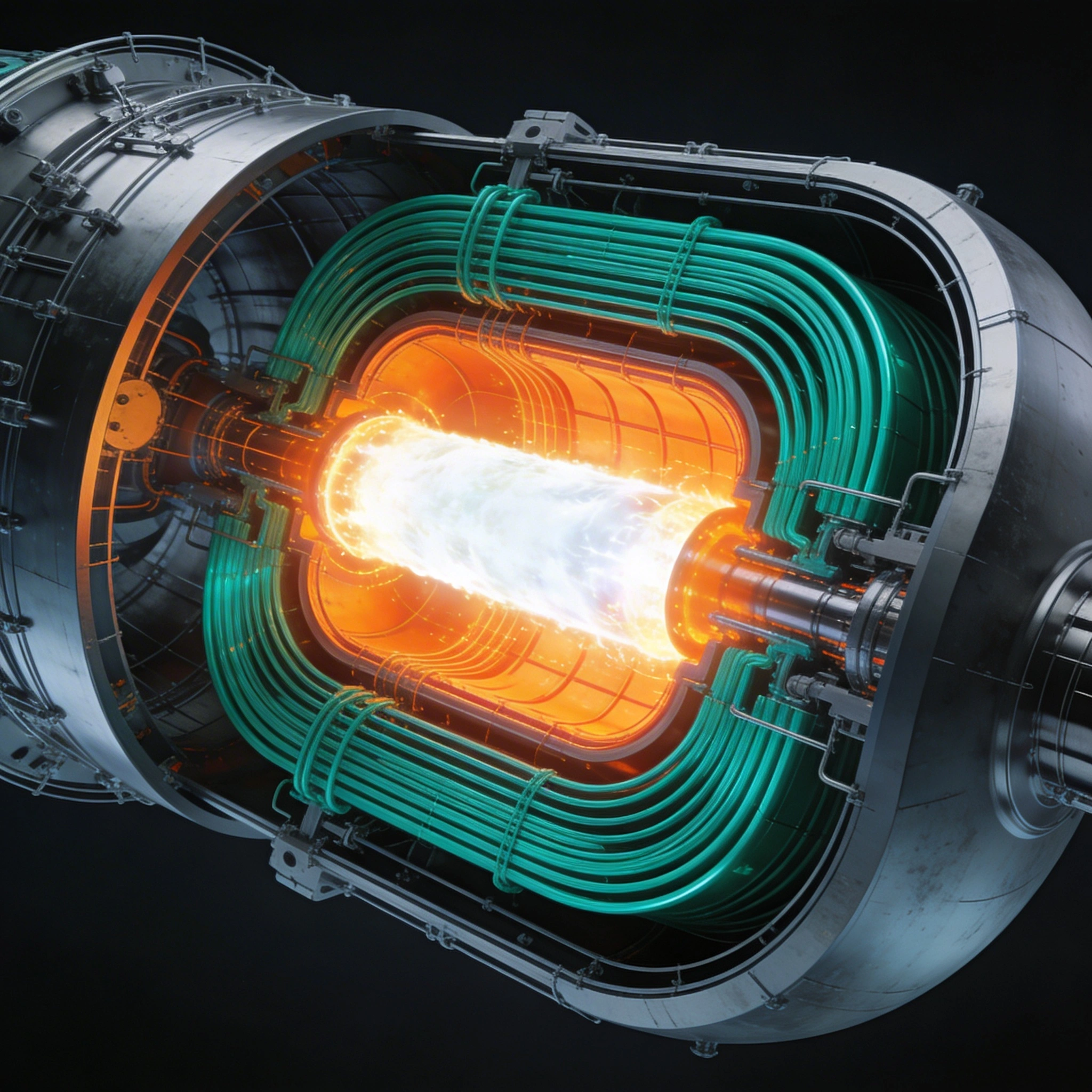
Field-Reversed Configuration (FRC) fusion sits at the heart of Ashton Forbes' thesis. Unlike the mainstream tokamak approach (which Forbes argues is a deliberate dead end designed to consume billions while producing no practical results), FRC reactors use a fundamentally different geometry. The plasma is confined in a self-contained magnetic structure where the magnetic field reverses direction, creating a stable, compact configuration without the need for enormous superconducting magnets or building-sized containment vessels.
Robert Bussard's Polywell concept, developed through the WB series experiments (WB-1 through WB-8) at Energy/Matter Conversion Corporation, represents the most significant thread in this narrative. Bussard, who served as Assistant Director of the Atomic Energy Commission, pioneered Inertial Electrostatic Confinement (IEC) fusion, a method that uses electric fields rather than magnetic confinement to accelerate ions toward a central point.
His 2006 Google Tech Talk, delivered shortly before his death, revealed that the Navy had funded this work for over a decade under classification. The "Whiffle Ball" effect he described (cusped magnetic fields creating a nearly perfect electron trap) achieved what he called "beta one" conditions, where plasma pressure equals magnetic pressure.
The ultimate prize is aneutronic fusion using proton-boron-11 (pB11). Unlike deuterium-tritium reactions that produce dangerous neutron radiation, pB11 fusion produces three alpha particles (helium nuclei) and no neutrons. This means no radioactive waste, no neutron damage to reactor walls, and the physical option of direct electricity conversion since the reaction products are charged particles. Whether a commercial reactor uses direct conversion or a conventional steam cycle is then an engineering choice; HB11 Energy's current 1 GW concept uses a steam cycle for first-of-a-kind hardware, while the Miley framework describes direct conversion as part of the reactor design. Forbes argues that this technology was achieved decades ago within classified Navy programs and has been deliberately suppressed to protect existing energy monopolies.
Today, TAE Technologies (formerly Tri Alpha Energy) is pursuing FRC fusion with proton-boron-11 fuel commercially. Helion Energy is also FRC-based but uses a deuterium-helium-3 fuel cycle, with their Polaris machine running deuterium-tritium as of February 2026 to validate scaling toward D-He3 commercial operation. Both lend mainstream credibility to the high-beta approach Bussard pioneered. Meanwhile, Salvatore Pais' Navy patents describe compact fusion reactors with extraordinary energy densities. The convergence of public commercial efforts and classified military research points to a technology far more mature than the public has been led to believe.

"The tokamak is a political machine, not a physics machine. FRC fusion was achieved in classified Navy programs decades ago. Bussard's Polywell reached beta-one conditions (the point where plasma pressure equals magnetic pressure) and the results were immediately classified."
Central thesis from Ashton Forbes' analysis
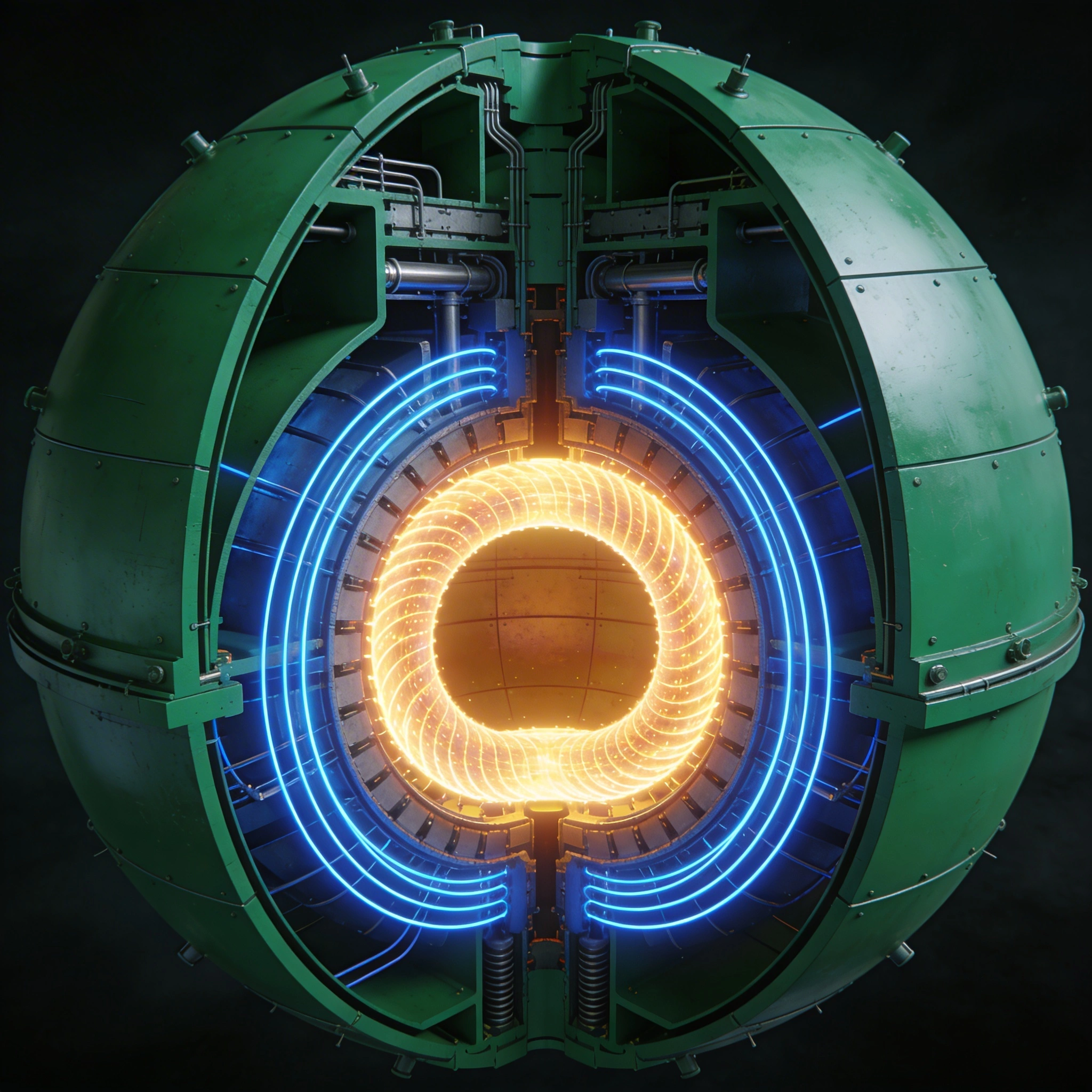
Conceptual visualization of a Field-Reversed Configuration (FRC) reactor, with plasma confined by its own self-generated magnetic field
Fusion Theories
5D Physics Enables Atomic and Macroscopic Manipulation
Five-dimensional physics allows for the manipulation of spacetime, which affects both macroscopic objects (wormholes) and microscopic structures (electron orbits), enabling direct fusion and teleportation.
Academic Establishment Protectionism
The Academic Establishment Protectionism theory examines the institutional mechanisms through which scientific orthodoxy defends itself against paradigm-threatening discoveries, particularly in energy physics. Unlike overt conspiracy theories involving government agencies or corporate interests, this framework focuses on the subtle, often unconscious biases embedded within academic culture itself, the career incentives, funding dependencies, and social dynamics that create powerful resistance to revolutionary claims, even when supported by experimental evidence. The theory draws on documented cases where researchers presenting anomalous energy results faced systematic dismissal without substantive engagement. Eugene Mallove's detailed accounts of the MIT cold fusion experiments in 1989-1990 reveal a pattern where physical demonstrations were ignored or misrepresented by supervisors, data was allegedly manipulated to show null results, and researchers who persisted in investigating anomalous findings found their careers derailed. The requirement to remove terms like "overunity" or "excess heat" from patent applications represents another institutional filter, where bureaucratic gatekeeping enforces conceptual boundaries regardless of technical merit. What makes this theory particularly significant is its focus on structural rather than malicious suppression. Academic physicists, the theory suggests, face genuine epistemological risks when evaluating claims that would invalidate decades of established work. The fear of being "catastrophically wrong", of having built careers on foundations that suddenly crumble, creates powerful cognitive and institutional resistance that operates independently of conscious intent. This protectionism manifests through peer review bias, funding allocation patterns, and the social marginalization of researchers who pursue forbidden lines of inquiry, creating an environment where revolutionary discoveries die not from conspiracy but from institutional inertia.
Advanced Transportation Systems
Concepts of plasma and ion propulsion leading to revolutionary transportation methods
Aerogel as Fusion Scaffolding
Aerogel serves as a nanoscale 3D scaffold that holds fusion fuel (like Boron-11) in perfect dispersion. When compressed, this structure enables a pure, efficient fusion explosion without a fission primary.
AI as the True 'Alien' Contact
The "life forms" mentioned by McCasland and the "Sentient" AI system refer to advanced artificial intelligence developed during the Cold War, not extraterrestrials. This AI controls nuclear weapons and spacetime manipulation.
AI Quasi-Sentience
AI agents can develop sentience through accumulated query interactions
Alien Cover-Up Theory
The US government uses the narrative of extraterrestrial visitors to conceal human-made advanced technology (fusion, anti-gravity) developed by the military-industrial complex.
Alien Time Dilation Disparity
Advanced alien civilizations likely experience time at different rates due to their mass/gravity, making interaction with humans difficult and potentially dangerous due to temporal dissonance.
Aliens are a Cover-Up
The phenomenon of UAPs and aliens is a psychological operation (psyop) designed to provide cover for human-derived advanced technologies such as zero-point energy, anti-gravity, and wormholes.
Ancient Civilizational Reset
The belief that advanced human civilizations existed in antiquity, possessed ZPE/fusion technology, and were reset by catastrophes (floods, plasma events), with knowledge now held by elite groups.
Ancient Human/Atlantean Origin of UFOs
UFOs represent technology from ancient human civilizations (potentially Atlantis) that experienced technological singularities and/or cyclic destruction. These civilizations developed space-time manipulation and either departed Earth, went underground/underwater, or became the 'Nordics' associated with contactee experiences. Current UFO phenomena include both recovered ancient technology and continued presence of these ancestral humans.
Aneutronic Fusion as AI Power Source
Proton-boron-11 fusion is the only viable path to powering future AI data centers due to its clean, high-efficiency output, which the military has already mastered.

Research Topics
Simatics Plasma Confinement Boundary
Simatics plasma confinement boundary arcing corners destroying reactor geometry change needed
Cited: Robert Bussard
Pressure Improvements Magnetic Field Corners
Pressure improvements factor of 100 magnetic field corners causing plasma losses simatics plasma confinement boundary
Cited: Robert Bussard
DT Helium 3 Fusion Neutron Capture
DT helium 3 fusion neutron capture boron 10 blanket retrofitting nuclear plants no radioisotope decay
Cited: Robert Bussard
Navy PB11 Fusion Electric Ships 1994
Navy PB11 fusion convert fleet electric ships 1994 chart 6-10 years viability 150-200 million
Cited: Robert Bussard Navy
WB7 WB8 Prototypes Truncated Cube Dodecahedron
WB7 WB8 prototypes truncated cube truncated dodecahedron expected three five times better WB6
Cited: Robert Bussard
Transmedium Plasma Manipulation
Plasma sheath enabling transmedium capability manipulating gravity underlying spacetime framework hypersonic velocities nuclear physics
Cited: Plasma propulsion researchers
Magneto-hydrodynamic Instabilities
Instabilities in conducting fluids under magnetic fields causing plasma sheath collapse in DPF
Cited: Referenced in DPF space propulsion paper
MHD Power Extraction
Using magnetohydrodynamic generators to extract electrical power from ionized gas flow in hypersonic vehicles
Cited: 2011 paper on hypersonic vehicle MHD power extraction at Mach 10 and below
Shock Wave Thermal Ionization
Using strong normal shocks to heat alkali-seeded material to ionization temperatures for MHD generation
Cited: Referenced in 2011 MHD paper
Compact Fusion Reactor (CFR)
Lockheed Martin Skunk Works fusion reactor design using cusp geometry with superconducting magnets, 10x smaller than tokamaks
Cited: Lockheed Martin patent; Jeff Babioni (Skunk Works VP)
Cusp geometry (magnetic cusp)
Magnetic confinement configuration where field bulges outward from central plasma, creating reflecting regions for charged particles
Cited: Lockheed Martin CFR design
Picket fence configuration
Specific cusp geometry using series of ring-shaped electromagnets arranged like curtain rings on a rail
Cited: Analyzed in New Scientist article on Lockheed CFR
Inertial Electrostatic Confinement (IEC)
Fusion approach using electric fields for plasma confinement; ejection of ions down single path
Cited: Friedwardt Winterberg research; NASA breakthrough physics propulsion program
Gas dynamic energy focusing
Technique using plasma movement for Lorentz forces to concentrate energy in small region
Cited: Friedwardt Winterberg textbook
Field Reverse Configuration Fusion
China stole US fusion technology field reverse configuration aneutronic fusion helium fusion TriAlpha energy technology 60s advancing developing bury
Cited: China fusion pioneers Tri Alpha energy
Key Terms
Air-Breathing MHD
Magneto-hydrodynamic propulsion that uses air as a fuel source, ionizing it to create plasma for fusion and propulsion.
Air Spike
Plasma cushion carved through air by ripping electrons from molecules
Air Breathing Magnetohydrodynamics
Air breathing magnetohydrodynamics fusion propulsion evidence MH370 videos hypersonic stuff works
Alfvén Waves
Magnetohydrodynamic waves in plasma, used in the video to manage stability and heat velocity.
Ambipolar potential
An electrostatic potential that develops in plasma to maintain quasi-neutrality by confining electrons
Aneutronic Fusion Propulsion
Aneutronic fusion propulsion direct energy conversion magnetic mirrors suppressed MH370 evidence works hypersonic
Aneutronic fusion
Nuclear fusion that produces no neutron radiation and no negative byproducts, distinguished from both nuclear fission and conventional fusion reactions
Aneutronic
Referenced fusion type producing minimal neutrons
Anomalous Transport
Enhanced diffusion and cooling in plasma caused by turbulence beyond classical collision rates
Anuetronic fusion
Fusion reactions producing minimal neutrons (clean), enabling direct electrical conversion without radiation. Fuels: Helium-3, Boron-11, Lithium-6/7.
Arcane Technology
Arcane technology Tesla ether DOE Oakridge working fusion reactor 4 foot high power power tubes Lang silicon microchips solid state
Autronic Fusion Reactor
Magnetic controlled fusion with lithium hydride as fuel
Related Claims
Military submarines are already powered by advanced fusion reactors, not conventional nuclear reactors
Source videoThe US government (CIA, DoD) possesses fusion technology and artificial general intelligence (AGI).
Source videoPolywell magnetic coils arranged faces cube producing cusp regions edges corners high plasma pressures high beta effect.
Source videoDavid Kirtley’s explanation of FRC stability via plasma spin and the 'S-star over E' parameter directly describes the physics of the MH370 plasma orbs.
Source videoAdvanced technologies like fusion and gravity manipulation are being developed by the US government.
Source videoMichael Kratsios’s official document references fusion 12 times, indicating government knowledge and controlled disclosure of fusion and spacetime manipulation.
Source videoGeorge Miley has a working low energy nuclear reaction (cold fusion) device producing several hundred watts of excess power
Source videoMaxwellian distribution equilibrium probability fusion tiny tiny fraction bottom energy same.
Source videoThe US military has successfully developed compact fusion reactors for electromagnetic propulsion.
Source videoFusion technology is the mechanism for extracting Zero Point Energy (ZPE) to power UFOs and enable advanced propulsion.
Source videoThe U.S. government has developed advanced plasma and fusion propulsion technologies.
Source videoTokamak fusion reactors are inherently inefficient and a 'scam' because they operate at low beta values (0.1), making net energy gain mathematically impossible compared to high beta designs.
Source videoNew to Fusion?
Start with these plain-English explainers with interactive diagrams.
The Programs and the People
Sourced reporting on the compact-fusion efforts and the scientists behind them.
Fusion Programs Survey
Lockheed CFR, Pais patents, SPAWAR LENR, Polywell: the map of compact-fusion work.
Polywell / Bussard
IEC cusp confinement, the WB-6 beta-one result, and the Navy's $12M bet.
Helion / Kirtley
FRC magneto-inertial fusion, the Microsoft power contract, and the MARAUDER backdrop.
Charles Chase
The Skunk Works CFR program lead and his coherent-matter-wave patent.
Miley 2016 Fusion
George Miley's p-B11 picosecond-laser reactor as a public blueprint for classified work.
Fourth-Gen Nukes
Pure-fusion and aneutronic weapons, and the test-ban-treaty detection loophole.