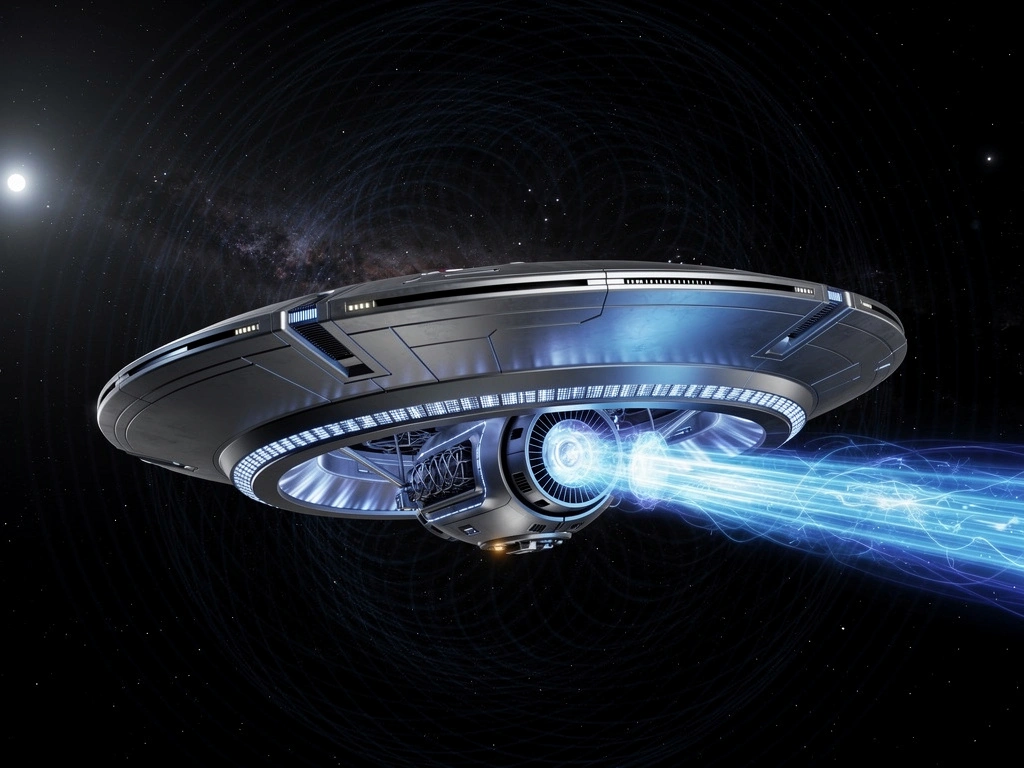
Advanced Propulsion
The Alcubierre warp drive, proposed in 1994, showed that general relativity technically permits faster-than-light travel by contracting space ahead of a vessel and expanding it behind; the vessel itself never exceeds the local speed of light. Forbes extends this concept through Gaussian cylindrical geometry, arguing that classified research has moved far beyond Alcubierre's original energy requirements.
The Pais Effect (named after Salvatore Pais, a Navy engineer who filed a series of extraordinary patents between 2016 and 2019) describes how high-frequency rotation of electrically charged matter can generate macroscopic spacetime distortion effects, potentially enabling inertial mass reduction and gravitational field manipulation.
Pais' Navy patents include a "Craft Using an Inertial Mass Reduction Device," a "High Frequency Gravitational Wave Generator," and a "Plasma Compression Fusion Device." The Navy took the extraordinary step of having the Chief Technology Officer of the Naval Aviation Enterprise file sworn declarations asserting these technologies were operable.
Forbes argues that these patents represent controlled disclosure of technology that has existed in classified programs for decades. The connection to EM drives and magnetohydrodynamic (MHD) propulsion provides an intermediate step: MHD systems use electromagnetic forces to accelerate conducting fluids (including ionized air or seawater), enabling propulsion without moving mechanical parts.
Anti-gravity research has a longer pedigree than most realize. Thomas Townsend Brown demonstrated in the 1920s-1950s that asymmetric capacitors (with different electrode geometries) experience a net force toward the smaller electrode when high voltage is applied: the Biefeld-Brown effect. While mainstream physics attributed this to ion wind, Brown's experiments in vacuum appeared to show residual thrust that couldn't be explained by ionic effects alone. His work was classified by the Navy and later by DARPA through Project Winterhaven. Forbes connects this to the Flux Liner, an alleged reverse-engineered craft that uses a rotating ring of capacitors to generate directional thrust through electrogravitic effects.
Scalar waves (Tesla's longitudinal electromagnetic waves) represent another thread. Unlike conventional transverse electromagnetic waves (where fields oscillate perpendicular to propagation), longitudinal waves have field oscillations along the direction of travel. While mainstream physics doesn't recognize propagating scalar waves in vacuum, Forbes argues they exist and enable technologies including through-barrier communication and energy transmission. The scalar electromagnetics guide covers where that vocabulary comes from, and why longitudinal waves are forbidden in vacuum yet completely routine in plasma. Transmedium flight (the ability of a single vehicle to operate in air, water, and space without modification) is the observable signature of these combined technologies. UAP reports from military pilots consistently describe objects demonstrating transmedium capability, suggesting an operational technology far beyond publicly acknowledged physics.

"The Navy filed patents for a craft using inertial mass reduction, and their CTO swore under oath that it works. Thomas Townsend Brown demonstrated electrogravitic thrust in the 1950s and was immediately classified. The Flux Liner isn't science fiction; it's engineering that uses physics we already understand but refuse to teach."
Forbes on suppressed propulsion technology
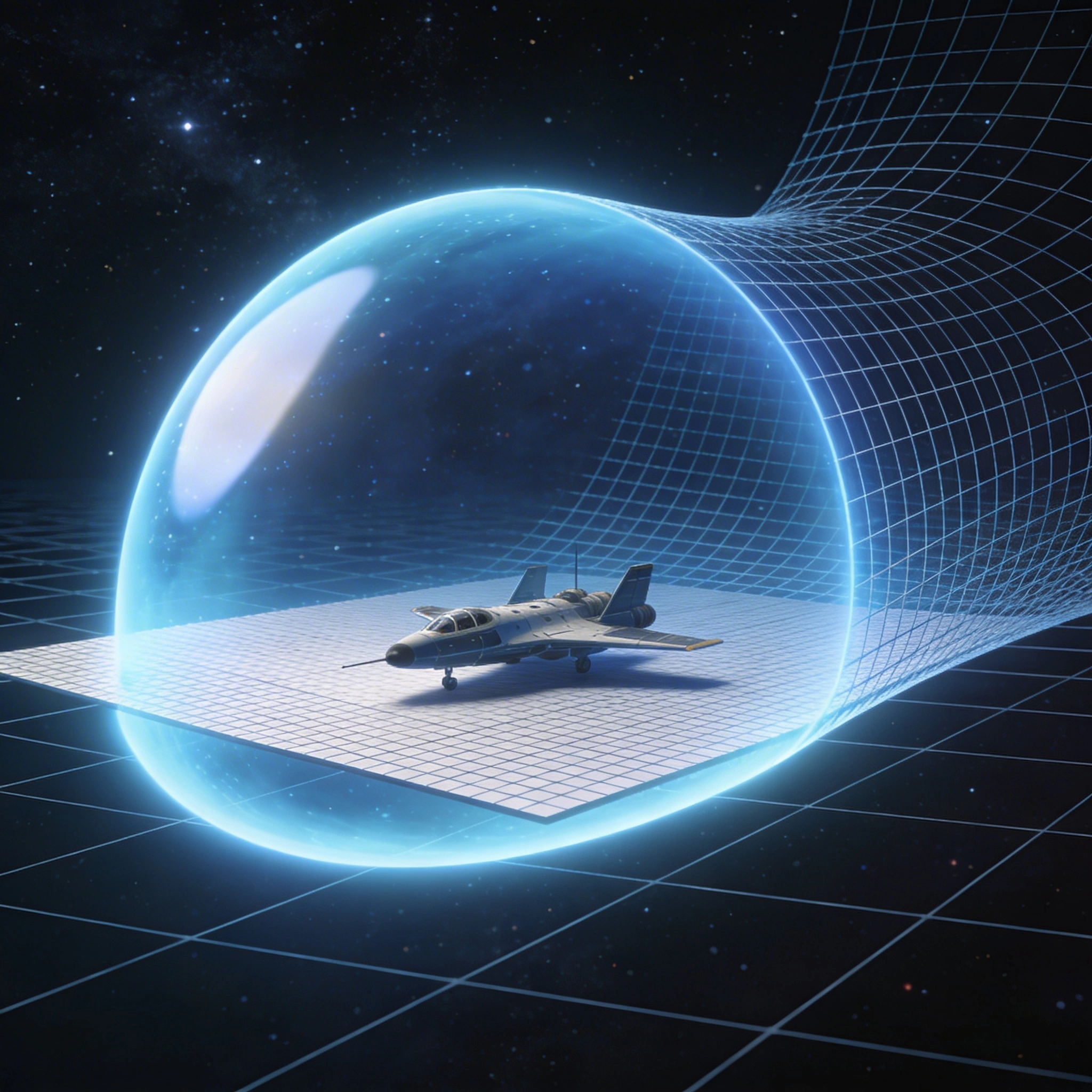
Alcubierre warp geometry: spacetime contracted ahead and expanded behind, enabling faster-than-light travel within general relativity
People in Propulsion Research
Harold Puthoff
Criticized for claiming not to know about negative energy technology
His polarizable vacuum model mentioned as framework for space-time manipulation
Salvatore Pais
Navy work Sal Pais watching Navy PB11 fusion electric ships
Referenced for his 'triarchy of sentience' concept (energy, processing capability, creativity) and connection to sentient AI development
Thomas Townsend Brown
Pioneer of asymmetric capacitor propulsion research (Biefeld-Brown effect)
Discovered propulsion effect from asymmetrical capacitors
Propulsion Theories
Accelerated Frame ZPE Manipulation
Inertia and gravity are consequences of ZPE interactions. By creating 'accelerated frames' (via undulators/ion pumps), one can break Lorent invariance and manipulate spacetime topology.
Adaptive Reality Paradigm
The Adaptive Reality Paradigm proposes a fundamental principle governing human civilization's capacity for technological and social progress: accurate information about reality, regardless of how threatening or paradigm-shattering it may appear, enables adaptive responses and advancement, while denial and suppression inevitably lead to systemic failure. This framework draws on historical case studies where institutional resistance to inconvenient truths produced catastrophic consequences that could have been avoided through earlier acceptance. The Vatican's suppression of heliocentrism during the Galileo affair serves as the paradigmatic example. By classifying Copernican astronomy as heretical and restricting its dissemination, the Church delayed the development of celestial mechanics for generations. When humanity finally accepted that Earth orbits the Sun, rather than the reverse, the accurate model enabled Newtonian physics, orbital mechanics, and ultimately spaceflight. A geocentric framework, maintained through institutional denial, would have made rocket science impossible, demonstrating how reality acceptance directly determines technological capability. The medical diagnosis analogy reinforces this principle: patients who acknowledge disease status can pursue treatment, while denial typically results in progression and suffering. Applied to the contemporary context of advanced propulsion, UAP phenomena, and energy technologies, the paradigm suggests that government secrecy and academic dismissal may be imposing similar costs. The Invention Secrecy Act, gravitational lensing anomalies, and magnetohydrodynamic propulsion research suppressed under classification may represent opportunities for adaptation that institutional denial prevents. Avi Loeb's Galileo Project exemplifies the alternative approach, direct observation and data collection regardless of whether findings challenge established cosmological assumptions. The theory implies that civilization's survival and flourishing depend not on protecting comfortable narratives but on developing the collective capacity to assimilate disruptive truths.
Advanced Transportation Systems
Concepts of plasma and ion propulsion leading to revolutionary transportation methods
Advantageous deployment
The Advantageous Deployment theory examines UAP behavior through the lens of tactical positioning, proposing that anomalous craft demonstrate systematic placement in locations optimized for observation, data collection, and strategic advantage. Rather than random or incidental appearances, this framework suggests UAP activity follows discernible patterns consistent with deliberate surveillance and assessment operations, positioning that maximizes information gathering while minimizing detection risk. The 2004 Nimitz incident, involving Commander David Fravor's encounter with the "Tic Tac" object, exemplifies this pattern. The UAP was observed at a precise location where Navy carrier strike groups were conducting training exercises, an area of high military activity where advanced sensor systems would be operational and where the tactical value of observation would be maximal. The object's demonstrated capabilities, including stationary hovering at 80,000 feet followed by rapid descent to sea level, suggest positioning technology that enables sustained presence in strategically valuable locations. FLIR footage and radar data from multiple platforms confirmed the object's presence in this advantageous location for extended periods. Station-keeping patterns observed in other military encounters reinforce this assessment. UAP frequently appear near nuclear facilities, missile test ranges, and advanced aircraft operations, locations where observation would yield maximum intelligence value. The theory distinguishes between random atmospheric phenomena and deliberate positioning by noting the consistency of these patterns across multiple incidents, the correlation with high-value military assets, and the demonstrated ability to maintain position despite environmental conditions that would affect conventional aircraft. The "transmedium" capability, transitioning seamlessly between air and water, further suggests positioning flexibility that enables observation from optimal vantage points regardless of environmental constraints. This deployment behavior implies not merely presence but purpose: systematic information collection on human military capabilities and intentions.
Aharonov-Bohm effect interpretation
The Aharonov-Bohm effect can be explained by the circular flow of the Planck ether and gravitational vector potential, indicating the presence of negative energy.
AI-Controlled Gravity Manipulation
The theory that the plasma orbs are controlled by AI because the complexity of managing gravity, fusion, and spacetime displacement exceeds human cognitive limits. This AI control was planned in classified documents prior to the public AI revolution.
AI Quasi-Sentience
AI agents can develop sentience through accumulated query interactions
Alien Cover-Up Theory
The US government uses the narrative of extraterrestrial visitors to conceal human-made advanced technology (fusion, anti-gravity) developed by the military-industrial complex.
Alien Technology Theory
A slightly humorous addition but essentially that advanced UFO technology far exceeds current human understanding.
Alien Time Dilation Disparity
Advanced alien civilizations likely experience time at different rates due to their mass/gravity, making interaction with humans difficult and potentially dangerous due to temporal dissonance.
Alien Travel Through Wormholes
Suggests that aliens use wormholes and zero point energy for interstellar travel.
Alpha Particles Alfven Waves
The Alpha Particles-Alfvén Waves theory addresses a critical challenge in magnetic confinement fusion: the self-heating of plasma through energetic alpha particles and the potentially destabilizing effects of Alfvén wave resonances. In deuterium-tritium fusion reactions, the primary energy output comes not as electromagnetic radiation but as kinetic energy carried by helium-4 nuclei, alpha particles, born with approximately 3.5 MeV of energy. These fast ions, if properly confined, transfer their energy to the bulk plasma through collisions, maintaining the high temperatures necessary for sustained fusion without external heating. The theory focuses on the complex interaction between these alpha particles and Alfvén waves, magnetohydrodynamic oscillations that propagate along magnetic field lines in magnetized plasmas. Under certain conditions, the velocity distribution of fusion-born alphas can resonantly drive Alfvén waves unstable, creating a feedback loop where wave growth leads to enhanced alpha particle transport away from the plasma core. This "anomalous diffusion" represents a critical threat to fusion reactor performance: if alphas escape the confinement region before thermalizing, the self-heating mechanism fails and the plasma cannot sustain fusion conditions. Research at MIT and other fusion laboratories has focused on understanding these resonant interactions, particularly in tokamak geometries where magnetic field curvature and plasma pressure gradients create complex wave-particle dynamics. The theory suggests that controlling Alfvén wave instabilities through magnetic field configuration, plasma density profiling, or active feedback systems may be essential for achieving the "burning plasma" regime where fusion self-heating dominates external heating. The connection to broader plasma phenomena, including magnetic reconnection and plasmoid formation, suggests that alpha-Alfvén interactions may play roles in astrophysical contexts as well, from solar flares to cosmic ray acceleration.

Research Topics
Navy PB11 Fusion Electric Ships 1994
Navy PB11 fusion convert fleet electric ships 1994 chart 6-10 years viability 150-200 million
Cited: Robert Bussard Navy
Maxwell's Equations
Classical electromagnetic theory; originally included scalar potential terms that were later removed by Heaviside
Cited: James Clerk Maxwell, Oliver Heaviside, Scientific documents, Ben Rich and Charles Chase
Warp drive
Technology equivalent to or exactly warp drive possessed by the US
Cited: Not specified
Anti-Gravity Propulsion
Propulsion systems manipulating gravitational fields eliminating weight enabling flight without aerodynamic lift conventional thrust mechanisms
Cited: Various advanced propulsion researchers
DIRDS (Defense programs)
Advanced research and development programs
Cited: Various defense contractors
Non-fission ignition triggers
Using plasma/electric triggers instead of atomic bombs to initiate fusion reactions, enabling 'clean' fusion devices without radioactive fallout.
Cited: Friedwardt Winterberg (textbook); Project Paperclip scientists
Stockpile Stewardship Program
DOE program using supercomputers and laboratory experiments to maintain nuclear weapons without underground testing
Cited: Established after end of Cold War testing
Charged Particle Propulsion
Propulsion method using electromagnetically directed charged particles expelled at high velocity to create thrust
Cited: Various fusion propulsion researchers
Propulsion Fusion Engine
Space engines thousand times better single stage Mars four weeks H to LEO 25 per kilogram 76 days Titan
Cited: Robert Bussard Space Dev Benson Space Company
Nuclear MHD Fusion Propulsion
Magnetohydrodynamic nuclear fusion propulsion systems described in 1998 breakthrough physics propulsion research
Cited: NASA Breakthrough Physics Propulsion
Wormhole Induction Propulsion
Eric W. Davis 1998 paper establishing energy density requirements for spacetime manipulation and wormhole creation
Cited: Eric W. Davis
Thermonuclear Spacetime Manipulation
Theory that thermonuclear weapons provide necessary energy density for measurable spacetime distortion effects
Cited: Eric W. Davis
Warp Drive Space Movement
Space warping around objects rather than objects moving through space enabling apparent faster than light travel
Cited: Miguel Alcubierre
Miguel Alcubierre Warp Drive
Theoretical faster than light propulsion mechanism contracting space in front and expanding behind spacecraft
Cited: Miguel Alcubierre
Maxwell's Equations (Original/Expanded)
Full electrodynamic theory including scalar and vector potentials that were later removed via gauge choices
Cited: James Clerk Maxwell
Key Terms
A-Vector Potential
A component of the electromagnetic field that, according to the video, can be conditioned to interact with gravity and spacetime, enabling propulsion and manipulation.
5D Scalar Physics
A theoretical framework by Ferris Williams that adds a fifth dimension to Einstein's equations, unifying gravity and electromagnetism and allowing for the manipulation of spacetime.
Ablative Implosion
Implosion driven by ablation of outer material layer
Advanced Propulsion and Energy Workshop
A forum for discussing futuristic energy and propulsion concepts, including the work of Paul Thibado
Ahronov-Bohm effect
A quantum mechanical phenomenon where particles are affected by the presence of an electromagnetic potential, demonstrating the reality of scalar potentials and the ether.
Air-Breathing MHD
Magneto-hydrodynamic propulsion that uses air as a fuel source, ionizing it to create plasma for fusion and propulsion.
Air Breathing Magnetohydrodynamics
Air breathing magnetohydrodynamics fusion propulsion evidence MH370 videos hypersonic stuff works
Alcubierre Drive
A theoretical solution in general relativity that allows for faster-than-light travel by contracting space in front of a ship and expanding it behind.
Alcubierre Froning Warp Drive
A propulsion system combining Froning's quantum ramjet concepts with Alcubierre's warp drive equations, utilizing a photon force field.
Alcubierre Metric
Mathematical solution to Einstein equations enabling warp drive
Alcubierre warp drive
A theoretical warp drive that uses negative energy to manipulate spacetime and achieve faster-than-light travel.
Alfvén Waves
Magnetohydrodynamic waves in plasma, used in the video to manage stability and heat velocity.
Related Claims
Discrete cylindrical nodes arranged in geometric shapes can create warp bubbles without requiring continuous energy rings.
Source videoThe US military has successfully developed compact fusion reactors for electromagnetic propulsion.
Source videoUFO propulsion utilizes 'spacetime metric engineering' and 'polarizable vacuum' to create wormholes.
Source videoFusion technology is the mechanism for extracting Zero Point Energy (ZPE) to power UFOs and enable advanced propulsion.
Source videoThe U.S. government has developed advanced plasma and fusion propulsion technologies.
Source videoTwo toroidal plasma configurations can geometrically rectify gravitational waves for propulsion
Source videoBussard interstellar ramjet collects interstellar hydrogen electromagnetic scoop hydrogen fusion drive.
Source videoSonny White found anomalous thrust in the EM drive while testing at NASA EagleWorks.
Source videoThe US government possesses operational teleportation and warp drive technology.
Source videoUAPs utilize advanced propulsion systems based on ZPE or thermonuclear fusion, allowing for unlimited power and motion without sonic booms.
Source videoMicrochips can be used to generate large forces for space propulsion and terrestrial applications.
Source videoSecret space program has operated for decades with advanced propulsion
Source videoNew to Propulsion?
Start with these plain-English explainers before the deep dives.
The Patents and the People
Sourced reporting on the propulsion physics and the researchers pursuing it.
Salvatore Pais Patents
The Navy patents for spacetime-modifying craft and the "Pais Effect."
H. David Froning Jr.
The aerospace engineer behind the vacuum-propulsion math in the orb-physics case.
The Propulsion Network
Puthoff, Davis, and Bussard: the vacuum-propulsion science network and its funding.