Fourth-Generation Nuclear Weapons
A Swiss physicist spent twenty years documenting a class of weapons the 1996 nuclear test-ban treaty doesn't cover. His papers are still on arXiv. Forbes thinks the MH370 orbs are the fielded version.
1 The Paper Trail
André Gsponer is a Swiss physicist who spent the 1980s and 1990s working on particle physics at CERN and then, in 1998, founded the Independent Scientific Research Institute (ISRI) in Geneva. ISRI had one unusual feature for a physics institute: it published detailed, openly-available technical analyses of nuclear weapons development. Not disarmament advocacy. Not policy papers. Engineering assessments.
Gsponer and his frequent collaborator Jean-Pierre Hurni began the project in 1997, when they distributed an early draft of 'The physical principles of thermonuclear explosives, inertial confinement fusion, and the quest for fourth generation nuclear weapons' at the INESAP Conference in Shanghai. The book ran through multiple corrected editions over the following twelve years, eventually published as INESAP Technical Report No. 1 and circulating widely in print, including a copy mirrored at the Cryptome archive. It runs to roughly 192 pages in its later editions. It's still online. Anyone can read it.
The companion paper, "Fourth Generation Nuclear Weapons: Military effectiveness and collateral effects" (Gsponer, October 2005, arXiv:physics/0510071, also issued as ISRI-05-03), establishes the public taxonomy. Three earlier generations, one emerging generation, and a treaty that was written for the old ones.
Key Gsponer Papers (ISRI, Geneva)
- Gsponer & Hurni (1997, multiple editions through 2009) "The physical principles of thermonuclear explosives, inertial confinement fusion, and the quest for fourth generation nuclear weapons." INESAP Technical Report No. 1 (~192 pp.). The master monograph; not on arXiv.
- Gsponer (Oct 2005) "Fourth Generation Nuclear Weapons: Military effectiveness and collateral effects." ISRI-05-03, arXiv:physics/0510071. Establishes the public taxonomy.
- Gsponer (Oct 2005) "The B61-based 'Robust Nuclear Earth Penetrator': Clever retrofit or headway towards fourth-generation nuclear weapons?" ISRI-03-08, arXiv:physics/0510052. The B61 case study.
- Gsponer (Sep 2005) "From the lab to the battlefield? Nanotechnology and fourth generation nuclear weapons." arXiv:physics/0509205. Civilian-to-weapons pathway.
- Gsponer (Sep 2004) "Physics of high-intensity high-energy particle beam propagation in open air and outer-space plasmas." arXiv:physics/0409157. Foundations for directed-energy and beam weapons.
- Gsponer & Hurni (Jul 2005) "Antimatter induced fusion and thermonuclear explosions." arXiv:physics/0507125. The antimatter-trigger pathway.
The scholarship is dense, and it's cited. Gsponer's papers appear in disarmament reviews, arms control journals, and the bibliography of almost every serious academic treatment of post-CTBT weapons physics. What he documented sits in the open record. The weapons community has been asking itself the same question since the mid-1990s.
Evidence Assessment
| Claim | Source | Confidence |
|---|---|---|
| Gsponer and Hurni published a detailed technical taxonomy of fourth-generation weapons | Gsponer 2005, arXiv:physics/0510071, ISRI-05-03; Gsponer & Hurni, INESAP Technical Report No. 1 (1997, multiple editions); cited in arms-control literature | Established |
| Pure fusion and subcritical devices exploit ambiguity in CTBT Article I language | Gsponer 2005 (arXiv:physics/0510071); Arms Control Today analyses; treaty negotiating history | Established |
| NIF crossed the net-gain threshold for inertial confinement fusion in 2022 | Lawrence Livermore press release, December 2022; DOE Office of Science | Established |
| A fielded pure-fusion device exists in the classified US arsenal | Gsponer analysis + program budget pattern; no direct confirmation | Informed |
| The MH370 orbs are fourth-generation fusion devices | Forbes' interpretation of orb signatures + Gsponer's physics taxonomy | Speculative |
2 Four Generations of Nuclear Weapons
Gsponer's taxonomy is what makes the rest of his argument work. Without a clean generational split, the treaty loophole is a blurry legal question. With it, the boundary is concrete.
The first three generations share a feature that matters for the treaty: they all need a fission chain reaction to function. A fission chain reaction produces a specific signature the CTBT was designed to detect: seismic, radionuclide, hydroacoustic, infrasound. The verification regime at Vienna watches for exactly that pattern, and the system works.
A fourth-generation device changes the picture. If the ignition isn't fission, the signature changes. If the yield is sub-kiloton, the seismic and radionuclide footprint can fall below the verification threshold. The detection chain the treaty relies on was never designed for a device that skips the fission step.
3 The CTBT Loophole
Article I of the CTBT is a single sentence: "Each State Party undertakes not to carry out any nuclear weapon test explosion or any other nuclear explosion, and to prohibit and prevent any such nuclear explosion at any place under its jurisdiction or control."
Two ambiguities became visible as soon as the drafting was done. First, nuclear explosion goes undefined anywhere in the treaty text. Second, test is left to the reader: what counts as a test versus a subcritical experiment?
During the 1995-1996 drafting, the US negotiating position was that "subcritical experiments" (hydrodynamic and hydronuclear tests at yields below the point of self-sustaining fission) would remain permissible, on the argument that they don't produce a nuclear explosion. The Clinton administration codified this in a series of ruling letters to the Department of Energy. Anything below the hydrodynamic threshold, by that reading, isn't covered.
Gsponer's observation was that this opened a corridor. A device that produces a yield of 0.1 kilotons from a pure fusion reaction doesn't involve a fission chain reaction at all, so the hydrodynamic question is moot. The device sits past the fission regime entirely. The treaty was written before anyone had seriously engineered such a thing, and the language doesn't cover it.
This is the explicit argument in Gsponer's 2005 'Military effectiveness' paper. He walks through the CTBT negotiating record, identifies where the treaty language assumes a fission-based detonation, and shows what a fourth-generation device would have to do to avoid each detection mechanism. The answer: produce a sub-kiloton yield with minimal neutron output, avoid radionuclide release by using non-activated fuel, and operate on a timescale short enough to evade seismic coupling. All three are engineering targets that align with aneutronic fusion.
Read carefully, Gsponer's argument is structural rather than accusatory. He doesn't claim the US is violating the treaty: he claims the treaty was written for the wrong weapon.
4 The Physics of a Non-Fission Trigger
What would it take to ignite fusion without a fission primary? Gsponer identifies three pathways, each with a distinct engineering profile.
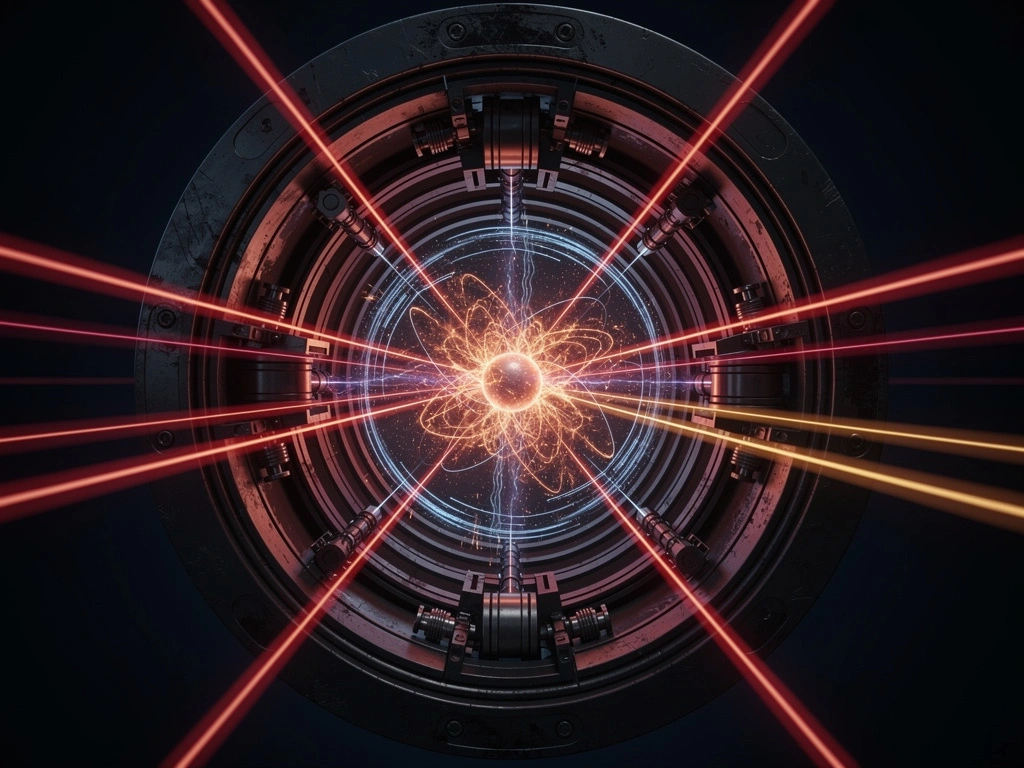
Inertial confinement fusion (ICF). A small fuel pellet is compressed and heated by converging laser pulses, particle beams, or X-ray radiation until fusion ignites. The National Ignition Facility at Lawrence Livermore is the civilian version of this, and in December 2022 it achieved net energy gain from a single shot: 2.05 MJ in, 3.15 MJ out. That's the ignition threshold. A weapons-relevant version would be smaller, faster, and deliver the initiating energy from a compact source rather than a 192-beam laser complex that fills a stadium.
Magnetised target fusion. A pre-magnetised plasma is rapidly compressed by an imploding metallic liner or an external magnetic field pulse. The plasma's own magnetic field suppresses thermal conduction losses during the compression, so the fuel reaches fusion conditions at much lower compression ratios than ICF. Los Alamos, General Fusion, and HB11 Energy all have public versions of this. Gsponer identifies it as one of the most plausible paths to a fielded pure-fusion device.
Antimatter-catalysed micro-fission-fusion. A few nanograms of antiprotons annihilating against a uranium or plutonium sub-critical mass produce enough local heating and fission output to ignite a surrounding fusion fuel layer. The antiprotons replace the fission primary. The device needs no critical mass, no implosion lens, no conventional nuclear materials in weapons-usable quantities. Gsponer and Hurni dedicated a full chapter to this in the 2009 monograph. The engineering challenge is producing and storing antimatter in useful amounts, but the physics is understood and the yield scaling works.
Two features link all three pathways. None of them require a supercritical fission assembly. All of them can be tuned to sub-kiloton yields. And the fuel, if aneutronic, produces minimal neutron activation of the environment.
That last point connects to the MH370 argument. An aneutronic fusion reaction, proton-boron-11 being the cleanest, produces its energy as charged alpha particles rather than fast neutrons. No neutron flash. No blue-white ionisation halo of the kind the Vela satellites were designed to catch. No radioactive decay products. If such a device was detonated, it wouldn't look like a nuclear event to the Defense Support Program's infrared sensors or the Space-Based Infrared System that replaced them. It would look like a compact thermal release with an odd spectral signature.
5 Why This Matters for MH370
On March 8, 2014, US officials told the press that the Defense Support Program had no record of any detonation event along MH370's flight path. The wording was careful and consistent: "no explosion," "no foul play observed," "no signature consistent with a break-up event." The Malaysian investigation accepted the statement.
That statement only eliminates one class of event. A fission or thermonuclear detonation produces a specific infrared and ultraviolet signature, shaped by the double-hump time profile that Vela and DSP have been calibrated against since the 1960s. A pure fusion device in the fourth-generation class doesn't produce that signature, because it has no fission stage to generate the characteristic UV flash.
So the US government's statement is literally true and analytically hollow at the same time. "No nuclear explosion" means "no fission-driven detonation." It doesn't mean "no exotic thermal event." And the sensors that watch the planet for fission-driven detonations aren't the same sensors that would catch a compact aneutronic plasma burst.
This is where Forbes' claim about the MH370 orbs finally connects to physics with a documented paper trail. If the orbs are field-reversed configuration plasmoids using aneutronic fuel (Forbes' specific claim, drawn from the same physics cluster Gsponer documented), they would produce:
- A compact thermal signature, visible in infrared but not matching the fission-detonation template
- No neutron flash, so no Vela-class detection
- No radioactive fallout, so no downwind radionuclide signature
- A visible glow consistent with plasma recombination, which is what the satellite videos appear to show
None of this proves the videos are authentic. It doesn't prove the orb-wormhole claim. What it does is remove one of the strongest standard objections: that the classified surveillance network would have detected a nuclear event and there's no record of one. The objection assumes the event would look like a nuclear detonation. Gsponer's work, twenty years before MH370, documented a class of devices that wouldn't.
6 What the Public Record Shows
Gsponer's central thesis was published two decades ago and the physics he identified has not been contradicted by any subsequent open-literature development. What has happened instead is that each milestone he flagged as plausible has quietly been met.
The National Ignition Facility crossed the fusion ignition threshold in December 2022 and reported gains above 1.5x in 2023. Commonwealth Fusion Systems and MIT demonstrated a 20-tesla REBCO superconducting magnet in 2021, the field strength Gsponer identified as the enabling step for compact magnetic-confinement devices. In January 2022, Margarone and colleagues published the first proof-of-principle laser-driven proton-boron fusion experiment using a PW-class laser in Applied Sciences (DOI 10.3390/app12031444), with HB11 Energy of Australia (founded 2017 by Heinrich Hora and collaborators) running the experimental programme. Los Alamos National Laboratory continues to operate the Atlas pulsed-power facility for magnetised target fusion experiments.
All of these are civilian or dual-use. None are fielded weapons. Gsponer's argument was never that the weapons already exist; it was that the civilian research path and the weapons research path are the same path, and that the civilian face is visible while the weapons face is not.
ISRI continued publishing until Gsponer's retirement in the mid-2010s. His papers remain online and the citation count keeps climbing. Arms-control scholars have engaged with the framework for years: the Bulletin of the Atomic Scientists, the Federation of American Scientists, and the SIPRI Yearbook all reference fourth-generation concepts in their coverage of the modernisation programs that Russia, China, and the US have been pursuing since the 2010s.
7 Open Questions
Three things would sharpen this analysis.
- Has any fourth-generation device been fielded? Gsponer argued it was possible and likely. Nothing in the declassified record confirms it. A FOIA request on Stockpile Stewardship program budget documents from 2005 onwards, cross-referenced against Los Alamos and Livermore personnel rosters for ICF and magnetised target fusion research, would narrow the question.
- What's in the classified ICF program? NIF is civilian. The Z Machine at Sandia is civilian. But the classified counterpart programs exist in the same facilities and share personnel. The boundary is policed tightly. FOIA releases from the National Nuclear Security Administration might show budget line items that don't map to the civilian programs.
- Does the CTBT verification regime track the possibility? The International Monitoring System at Vienna operates on assumptions written in 1996. Has it been updated to account for aneutronic or antimatter-catalysed events? If not, why not? The treaty organisation's technical reports should answer this, and they are public.
None of these questions require insider access. They require patient document work.