Charles Chase
The Lockheed Skunk Works senior fellow who promised a 100-megawatt compact fusion reactor on Google's stage in 2013, ran the program until October 2018, and holds a 2016 Lockheed patent on coherent matter wave beams.
1 The Promise on a Google Stage
On February 7, 2013, Charles Chase walked onto Google's Solve for X stage in Half Moon Bay and made a promise on Lockheed Martin's behalf: a 100-megawatt fusion reactor in five years, a fully engineered power plant in ten. The video was uploaded by Google's X channel four days later. It's still public.
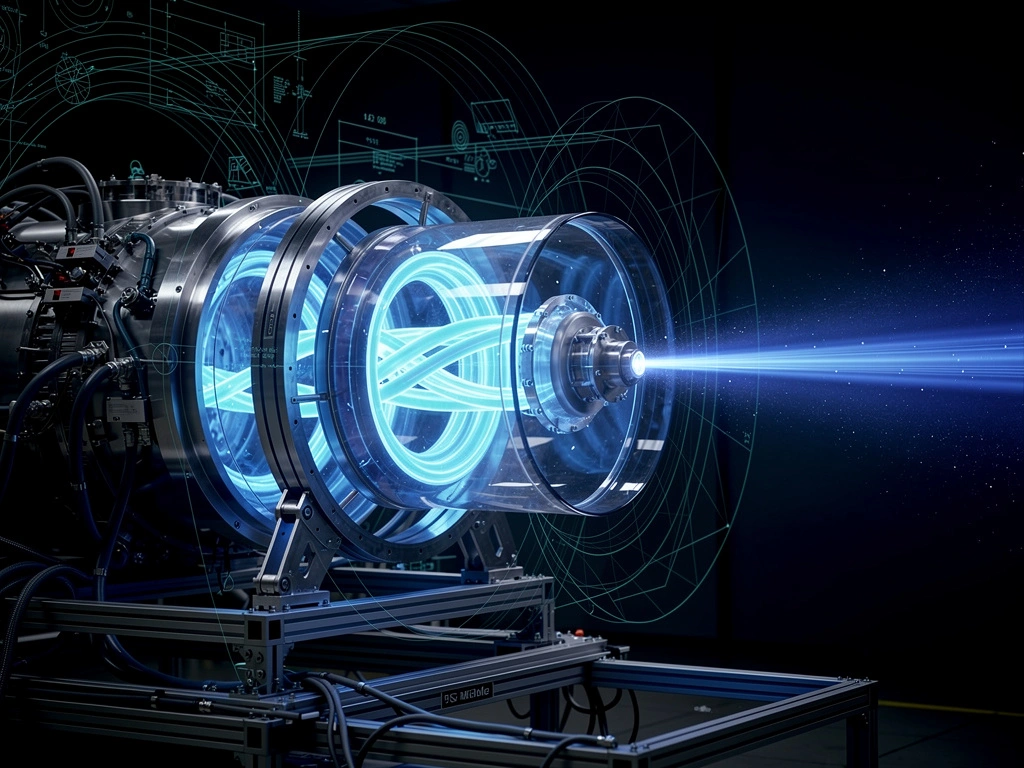
His framing was unusual for a Skunk Works engineer. Classification language was nowhere in the talk. On stage, he named the inventor on his team: Tom McGuire, "the guy who's come up with our brand new concept." Slides showed the experimental hardware, a roughly 1-metre by 2-metre cylinder. The engineering target was specific: a reactor with the complexity of a jet engine, not a major infrastructure project. And the audience heard a 100-megawatt machine could fit on the back of a truck.
That's the sentence that stuck. A truck-mounted fusion reactor. Lockheed's senior Skunk Works engineer, on Google's stage, in 2013.
Three direct quotes from the talk anchor the rest of this page.
"100 megawatt of power, enough power for a small city of 50 to 100,000 people, and something that would fit on the back of a truck."
That's the engineering claim.
"We could even enable fast space travel, so we could get to Mars in a month versus six months."
That's the propulsion claim. Chase named compact fusion as a propulsion technology, not just a power source. A Mars trip in a month. Said publicly, on the record, in February 2013.
"5 years from now we could have a 100 megawatt prototype reactor and then in a 10-year time frame a fully engineered power plant based on this approach."
That's the schedule. Prototype by early 2018. Power plant by early 2023. We'll come back to that.
Evidence Assessment
| Claim | Source | Confidence |
|---|---|---|
| Chase ran Lockheed Skunk Works' Compact Fusion Reactor program from inception through October 2018 | Chase's UnLAB-hosted resume; 2013 Solve for X talk; 2014 Aviation Week reveal | Established |
| US Patent 9,502,202 B2 names Chase and Moe J. Arman as inventors of the coherent matter wave method | USPTO record, granted 2016, assignee Lockheed Martin Corporation | Established |
| Tom McGuire, not Chase, is the named inventor on the CFR confinement patents (US 9,959,942 family) | USPTO record, granted May 1, 2018 | Established |
| The CFR program halted between Chase's 2018 retirement and August 2020 | Aviation Week (Steve Trimble), August 30, 2023 | Strong |
| UnLAB receives research grants from DARPA/DSO, ONR, and the Limitless Space Institute | Chase resume, hosted on the UnLAB site (2021) | Strong |
| The coherent matter wave patent's physics is consistent with the visible behaviour of the MH370 orbs | Forbes' video analyses; patent text on Aharonov-Bohm phase locking | Informed |
| Chase personally engineered the orb hardware seen in the MH370 footage | Forbes' inference from Chase's resume and patent record | Speculative |
2 The 2014 Reveal
By October 15, 2014, the program had a name and a press kit. Lockheed's Skunk Works publicly unveiled the Compact Fusion Reactor at a facility tour, with Aviation Week's Guy Norris breaking the technical detail in a same-day piece, "Skunk Works Reveals Compact Fusion Reactor Details." Chase served as the program's senior fellow and spokesperson. Tom McGuire was identified as chief designer.
The 2014 announcement repeated Chase's 2013 framing: 100 MW, compact form, jet-engine-level complexity, and a target of a working reactor within a decade. Lockheed filed patent documentation around the same time. The "Encapsulating Magnetic Fields for Plasma Confinement" patent (US 9,959,942) granted on May 1, 2018, with McGuire listed as the inventor. A sister patent, "Magnetic Field Plasma Confinement for Compact Fusion Power" (US 9,947,420), covers the field-reversed geometry. McGuire is the named inventor on both. Chase's name doesn't appear on the CFR patents themselves: he was the program's leader and public face, not its lead patent author.
The engineering team beyond Chase and McGuire surfaces in the program's APS Division of Plasma Physics papers. Gabriel Font (Lockheed Martin Fort Worth) and Artan Qerushi (Senior Research Development Scientist at Lockheed Martin, PhD plasma and high-temperature physics, University of Florida 2000) co-authored the 2016 and 2018 T4B experiment papers with McGuire. The team was named in the open scientific literature, not just internal Lockheed material.
That distinction matters. The page isn't arguing Chase invented the confinement physics. The page is arguing Chase ran the program that built the experiment, recruited the team, and committed Lockheed Martin's senior leadership to a public timeline.
3 Chase's Engineering Record
Chase's resume, hosted on the UnLAB site, documents his Lockheed career in his own words. The role description is plain:
"Founder and Leader of Revolutionary Technology Programs, the organization at the technological front end of the Skunk Works."
His Lockheed tenure runs from 1986 to 1991, then again from 1994 to October 2018. He retired as a Senior Tech Fellow, a rank described in his resume as "a distinction reserved for the top 0.1% of the technical talent in the corporation." Education: BS in electrical engineering and computer science from UC Berkeley, 1985, with an electromagnetics concentration. Earliest Lockheed work involved low-observable research on the F-117A.
The CFR was one project among many. The 2018 portfolio in his Revolutionary Technology Programs office included compact fusion, hypersonic systems and materials, adaptive structures, "breakthrough power and propulsion, from the here and now to the can't-believe-it's-possible," metamaterials, photonics, and one item worth quoting in full:
"Novel particle, neutral, and intelligent wave front beams, we build our own beams."
We build our own beams. Chase wrote that sentence on his own resume. The Revolutionary Technology Programs organization had an in-house beam-engineering capability that wasn't just lasers. That fact alone is consistent with the Forbes thesis about the orb signature, but it's also a verifiable, public, first-person claim in Chase's own employment record.
The patent list on the resume is short and specific:
"Granted US patents include: 'Improved Aircraft Runway', 'Systems and Methods for Plasma Jets', 'Over-wing traveling-wave axial flow plasma accelerator', 'Aharonov-Bohm Sensor', 'Pyroelectric Power from Turbulent Airflow', 'Coherent Matter Wave', 'Cognitive Enhancement through Feedback Control', and 'Mask Integrated Physiological Sensor'."
Two of those patents share the same physics: the 'Aharonov-Bohm Sensor' and the 'Coherent Matter Wave.' Both involve the AB effect, a quantum-mechanical phenomenon in which the phase of a charged particle's wavefunction shifts in the presence of a magnetic vector potential. The Aharonov-Bohm Sensor patent uses the effect for detection. The Coherent Matter Wave patent (US 9,502,202 B2, granted in 2016, with co-inventor Moe Arman) uses it to induce coherence in a matter wave beam. Both are assigned to Lockheed Martin.
Chase has briefed the JASONS, the Department of Energy, the Office of the Director of National Intelligence, the Under-Secretary of the Navy, and the Lockheed Martin Board of Directors. That's a list from his own resume, not a third-party characterisation. Whatever you make of his claims, his audience has been the senior US science and defence advisory community.
4 The Project That Was "Breathing on Its Own"
The most consequential single sentence in Chase's resume is about the CFR program.
"Conception, implementation, and management of the Compact Fusion development program, a new approach to hot fusion that can provide 100 MW of power in a compact form. I convinced senior LM leadership to invest significant company resources into the development of a very high risk, game changing technology. This was achieved through an 8-year persistence of vision in the face of the typical large corporation bureaucratic inertia and risk-adverse committee-based decision making. The project is now breathing on its own, and the experimental and simulation campaign has been very successful to date."
Read that line slowly. As of the resume's 2021 web posting, with Chase having retired in October 2018, the CFR was "breathing on its own" and the experimental campaign was "very successful to date." That's the program's own architect, in writing, on his own institution's website.
Now compare against what Aviation Week's Steve Trimble reported on August 30, 2023: a top Lockheed Martin executive confirmed on August 28, 2023 that the CFR project had been cancelled, and that the cancellation had occurred "at least three years ago." So somewhere between Chase's 2018 retirement and August 2020, an experimentally successful, well-funded compact fusion program at Lockheed Martin's Skunk Works was halted. The public reasons given are minimal.
If the program was breathing on its own and producing successful experimental results in 2018, what caused the cancellation, and where did the team and the experimental hardware go? Lockheed hasn't said. Aviation Week's reporting frames it as a quiet shutdown, not a public failure announcement.
The 2013 schedule called for a working prototype by early 2018 and a full power plant by 2023. Chase retired in October 2018. The program ended by 2020. The public deliverables didn't appear. Whether that's because the physics didn't pan out, the funding shifted to a classified follow-on, or the technology matured into a non-public programme isn't knowable from the open record. We don't pretend otherwise.
5 Coherent Matter Waves: The Bridge
Chase's resume names a second technology worth examining separately from the CFR. It has its own patent, its own inventors, and its own physics.
US Patent 9,502,202 B2, 'Systems and methods for generating coherent matterwave beams,' was granted to Charles Chase and Moe J. Arman in 2016, assigned to Lockheed Martin Corporation. The mechanism described in the patent uses the Aharonov-Bohm effect under a noise-seeded resonance condition to phase-lock and beam matter waves, in a manner analogous to how a laser phase-locks photons.
A laser produces coherent light. A coherent matter wave beam, as the patent describes it, would produce coherent matter. The patent's claims discuss applications including atomic-scale manufacturing (matter waves used to deposit atoms with sub-nanometre placement) and beam transport of mass over distance. It is, on its face, a wildly ambitious patent.
The patent isn't a working device. It's a patent on the methods by which such a beam could be generated. But the inventor list, the assignee, and the granting date are matters of US public record. Lockheed Martin holds a 2016 patent, with Chase as named co-inventor, on a method for phase-locking matter waves using the AB effect.
Why this matters for the orb thesis is direct. Forbes argues that the visible behaviour of the MH370 orbs (their geometric stability, their apparent ability to project structure, their coherent group dynamics) is consistent with a coherent matter wave system rather than simple plasma propulsion. Whether that interpretation is correct is a separate question. The point for this page is narrower: Lockheed's Skunk Works Revolutionary Technology Programs office had a granted patent on coherent matter wave generation, with the program lead as a named inventor, before the orb footage entered public discussion. That sequencing matters.
6 From Skunk Works to UnLAB
Chase retired from Lockheed Martin in October 2018 and co-founded UnLAB, a 501(c)(3) non-profit. From the resume:
"Co-Founder, Director and CTO of the UnLAB, a 501(c)(3) non-profit dedicated to working with our collaborators on the development of advanced technologies and products that are good for people, the biome, and that further human understanding. Currently executing fundamental research grants for DARPA/DSO, Office of Naval Research, and the Limitless Space Institute, collaborating with Stanford, Princeton, UCLA, and Technion."
UnLAB's funder list is the part worth flagging. DARPA's Defense Sciences Office, the Office of Naval Research, and the Limitless Space Institute. The first two are mainstream US defence research funders. The third is more specific: the Limitless Space Institute is also where Sonny White's vacuum-engineering work lives, the same Sonny White covered in our Casimir cavity research page. Chase's post-Lockheed non-profit and White's institute are linked through grant funding.
On October 5, 2025, UnLAB published a post under Chase's authorship announcing what the site calls a "Phase-Controlled Matter Beam." The substance: a method for precisely controlled 3-D atomic-scale printing and additive manufacturing at wafer scale, claimed feature sizes down to 0.2 nanometres, without the use of masks. The mechanism described combines the Aharonov-Bohm effect with Kuramoto-type coupled oscillator synchronization, implemented through a synchronized array of coupled low-energy emitters that maintains phase coherence across the beam.
That announcement is the public continuation of US Patent 9,502,202 B2. The 2016 patent described phase-locking matter waves through the AB effect under noise-seeded resonance. The 2025 UnLAB post applies the same physics, with explicit feature-size and wafer-scale claims, to atomic-scale fabrication. The work didn't stop at Chase's October 2018 Lockheed retirement. It moved with him to UnLAB, kept the same physics core, and surfaced publicly seven years later as a manufacturing technology rather than a propulsion or beam-weapon framing.
7 Connection to the MH370 Orb Thesis
Ashton Forbes has named Chase in 33 separate video analyses indexed in the 4Orbs pipeline. Across those, Chase is consistently positioned as one of the few publicly named engineers whose patent record and program leadership match the engineering profile required to build the visible orb hardware. Chase himself hasn't commented publicly on the MH370 footage. Forbes' argument is structural, not personal.
That structural argument runs as follows. A device producing the visible orb behaviour would require three engineering pillars: a compact, high-density energy source (compact fusion fits); a non-thermal plasma confinement geometry (the high-beta field-reversed configuration fits); and some method of projecting structure or mass coherently over distance (coherent matter wave beams fit). Lockheed's Skunk Works has documented public work on all three pillars, with Chase as program lead on the first two and named co-inventor on the third.
That convergence isn't proof. It's a publicly documented capability stack at a single contractor, operated under classification constraints, run by a small team that includes the named subject of this page. Whether Chase personally engineered the MH370 hardware, or someone else inside Skunk Works built it from the same overlapping technology, is the part that stays genuinely open, and Forbes frames it as a structural inference rather than a claim about one man's hands. That scoped caveat doesn't weaken the strand. A three-pillar capability stack (compact fusion for the energy source, a high-beta field-reversed geometry for confinement, and an in-house "we build our own beams" line for coherent projection) documented at one Skunk Works program is exactly the corroboration the cumulative MH370 case predicts, whoever inside the program built the hardware. Set it beside the vacuum-engineering lineage on our Sonny White and propulsion-network pages, and it reads as one more strand on the stack rather than a coincidence to explain away.
What the open record does support: Chase ran a fusion program at Lockheed that was publicly committed to a 100-MW reactor by 2023, retired before the deliverable appeared, and the program quietly ended by 2020 with no formal cause given. He also holds a patent on coherent matter wave generation that, on its face, describes a technology with no civilian analogue. Both claims are anchored in primary sources: Chase's own resume, Chase's 2013 talk, the USPTO patent record, and Aviation Week's reporting.
8 Open Questions
- Who is the named Lockheed Martin executive who confirmed the program halt to Aviation Week in August 2023? The exec's name behind the August 28, 2023 confirmation would tell us the level inside Lockheed at which the cancellation was being discussed. The Aviation Week piece is paywalled and the name doesn't propagate to secondary coverage. Best inference (not verification): John Clark, who succeeded Jeff Babione as Skunk Works VP/GM in March 2022 and was the senior figure available to discuss the program's state in mid-2023.
- What was the formal reason given for the cancellation, if any? Aviation Week's coverage frames it as a quiet shutdown. No public failure analysis, no replacement program announcement, no reorganisation note. Lockheed's annual reports and SEC filings for the relevant years don't carry a targeted CFR mention. This is a genuinely open question.
- Where did the CFR team end up after the program halt? Partially answered. Tom McGuire is still at Lockheed Martin Aeronautics, listed publicly as Research Engineer and Scientist with the title "Lockheed Martin Fellow and Principal Investigator of the Compact Fusion Reactor Project." Gabriel Font and Artan Qerushi (both named on the T4B papers) appear in Lockheed Martin filings through 2018. The named engineers stayed inside Lockheed rather than dispersing to private fusion startups. Whether they're now on a classified successor program or simply reassigned to other Lockheed work isn't determinable from the public record.
- Has UnLAB produced public output since 2021? Yes. On October 5, 2025, UnLAB announced a Phase-Controlled Matter Beam method for atomic-scale 3-D printing, applying the Aharonov-Bohm physics from US Patent 9,502,202 B2 with explicit feature-size and wafer-scale claims. Three 2022 conference items also appear on the site (Steven Wolfram, James Gimzewski, and the fourth annual Advanced Propulsion & Energy Conference). The matter wave work continues under Chase's name on UnLAB's domain.
- If the program was breathing on its own in 2018 with successful experimental results, what does it mean that it ended by 2020 with no public deliverable? The two clearest readings (the physics didn't pan out vs. the work moved into classified channels) have very different implications. Neither is currently provable from the open record. The fact that McGuire stayed inside Lockheed in his CFR PI role lends marginal weight to the second reading without confirming it.