Magnetic Confinement
Tokamaks vs. FRC: Why It Matters
The 30-Second Version
The problem: Fusion requires heating hydrogen to 150 million degrees, ten times hotter than the center of the sun. At that temperature, no physical container can hold the plasma. It would melt through anything. So how do you contain something that destroys everything it touches?
The solution: Magnetic fields. Because plasma is made of charged particles, strong magnets can push the plasma away from the walls without touching it. It's like levitating a ball of liquid fire using invisible force fields. This is the entire basis of fusion energy research.
The debate: For 70 years, most fusion funding has gone to one design: the tokamak (a giant donut-shaped reactor). But a growing number of physicists believe a much simpler, more compact design called Field-Reversed Configuration (FRC) may be far superior. This is central to Forbes' thesis about suppressed energy technology.
Two Approaches to Confinement
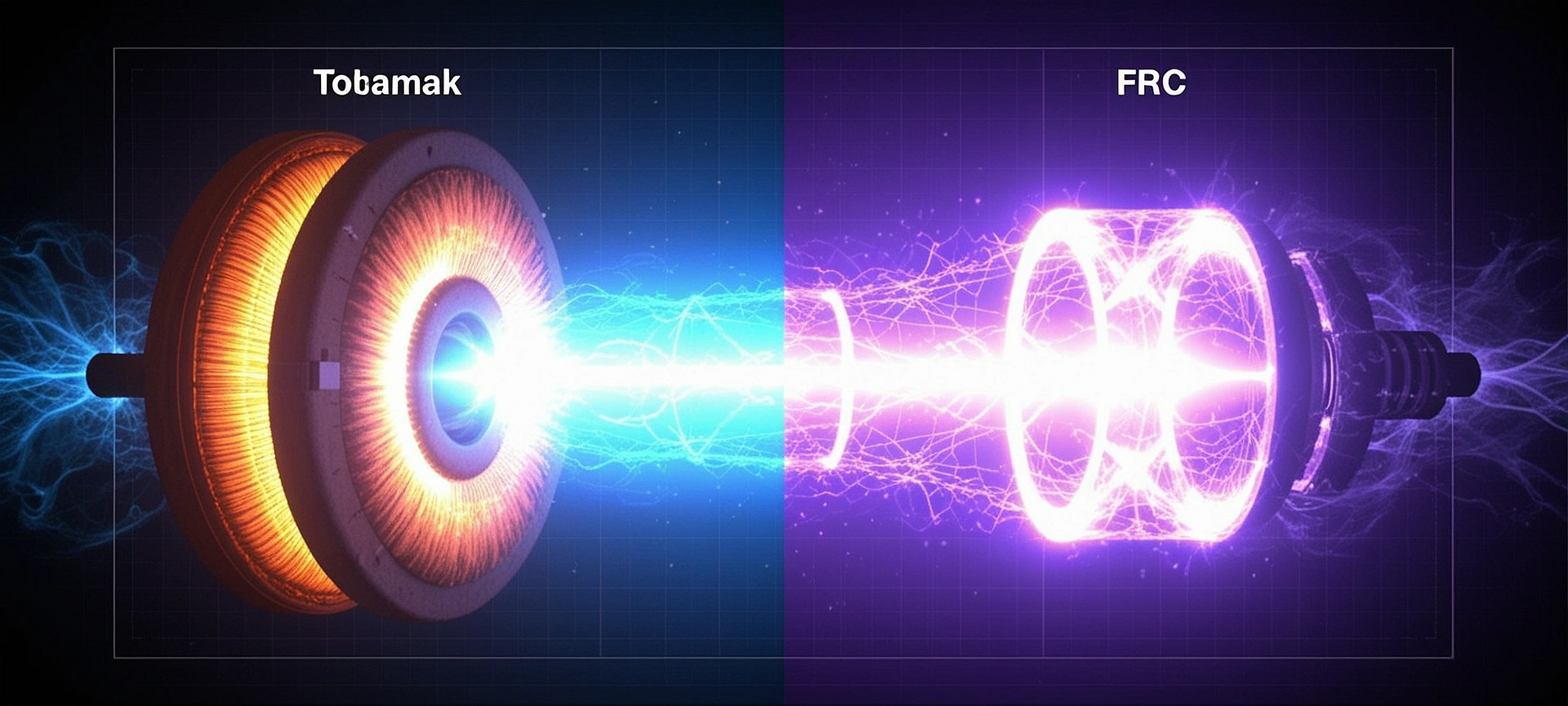
The diagram below compares the two designs side by side. Notice how much more plasma (the glowing particles) fills the FRC cylinder compared to the thin ribbon inside the tokamak donut.
How It Works
The magnetic bottle
Charged particles spiral around magnetic field lines. If you shape the field into a closed container, the particles can't escape. This is the basic principle. The hard part is making the container leak-proof: plasma is incredibly good at finding tiny gaps in the magnetic field. Even a small instability can cause the entire plasma to slam into the reactor wall in microseconds, ending the fusion reaction instantly.
The tokamak approach
Imagine a donut. Plasma circulates inside the tube of the donut. Huge magnets wrap around the outside to create the confining field. The problem: it's inherently inefficient. Most of the reactor volume is magnet, not plasma. The plasma pressure is only about 5% of the magnetic pressure (β ≈ 0.05). You need enormous, expensive magnets to confine a thin ribbon of plasma.
Scale check: ITER, the world's largest tokamak being built in France, weighs 23,000 tons and costs $25+ billion. It won't produce net energy until the 2030s at the earliest, after more than 30 years of construction and design.
The FRC approach
Now imagine a cylinder. Instead of the magnetic field running one direction everywhere, the field reverses direction at the center. This creates a closed loop where field lines curve back on themselves, trapping the plasma inside. The result: plasma fills most of the reactor volume, the plasma pressure nearly equals the magnetic field pressure (β ≈ 1.0), and the whole device can be room-sized instead of building-sized.
The name says it all: "Field-Reversed Configuration." The field reversal is the key insight. Instead of fighting the plasma with brute-force magnets, FRC works with the plasma's own magnetic field. The plasma's internal currents help hold it together, creating a self-confining structure.
What "beta" means and why it matters
Beta (β) is the ratio of plasma pressure to magnetic pressure. A β of 0.05 means your magnets are doing 20x more work than necessary. A β of 1.0 means every bit of magnetic energy is being used efficiently. Higher beta = more compact reactor = cheaper = potentially portable.
Tokamak: β ≈ 0.05
5% efficient. Massive magnets confine a thin plasma ribbon. Building-sized. Billions of dollars.
FRC: β ≈ 1.0
100% efficient. Plasma fills the reactor. Room-sized or smaller. Orders of magnitude cheaper.
This is why FRC is so significant, and why Forbes argues it's been suppressed. A compact, cheap fusion reactor would upend the entire global energy economy overnight.
Why This Matters for 4Orbs
If FRC reactors can be made small enough, they could fit inside a vehicle, or an orb. Forbes claims the MH370 orbs are FRC-based plasmoid devices: self-contained plasma structures held together by reversed magnetic fields, generating their own energy through aneutronic fusion. A portable sun, essentially.
Robert Bussard (the inventor of the Polywell FRC variant) gave a famous Google Tech Talk in 2006 claiming the Navy classified his research after his WB-6 experiment showed promising results. He described achieving "beta one" conditions (the holy grail of magnetic confinement) in a device you could fit in a garage. He died in 2007, and the Navy continued the research under classification.
Mainstream vs. Speculative
We distinguish established science from unverified claims so you can evaluate the evidence yourself.
Mainstream
- Magnetic confinement of plasma is well-established physics.
- Tokamaks work; they've achieved fusion (though not yet net energy gain commercially).
- FRC is real and being researched commercially by TAE Technologies and Helion Energy.
- Beta is a standard plasma physics metric used in every textbook.
Speculative
- That FRC has been perfected in classified Navy programs.
- That Bussard's work was deliberately suppressed after achieving breakthrough results.
- That portable FRC devices could explain the MH370 orbs.
- These claims go well beyond published research.
Key Terms
Magnetic Confinement
Using magnetic fields to trap and hold plasma in a controlled region, preventing it from touching (and destroying) the reactor walls. The foundation of all fusion reactor designs.
Tokamak
A donut-shaped (toroidal) fusion reactor design where external magnets confine plasma in a ring. The dominant approach since the 1960s. Examples: ITER, JET, EAST.
FRC (Field-Reversed Configuration)
A compact fusion design where the magnetic field reverses direction at the center, creating a self-confining plasma structure with near-perfect efficiency (β ≈ 1.0).
Beta (β)
The ratio of plasma pressure to magnetic pressure. A key efficiency metric. Higher beta means more plasma per unit of magnetic energy. Tokamaks: ~0.05. FRC: ~1.0.
Polywell
An FRC variant invented by Robert Bussard that uses a polyhedral arrangement of magnetic coils to create cusped fields. Developed under Navy funding through the WB experiment series.
Plasma Pressure
The outward force exerted by hot, dense plasma. In a fusion reactor, this must be balanced by the inward force of the magnetic field to maintain stable confinement.