Helion Energy and David Kirtley
The compact fusion company that signed the first commercial fusion contract on the open record, runs the geometry Forbes points at when discussing the MH370 orb signature, and traces its technical lineage through DARPA, NASA, and a plasma propulsion programme that quietly produced fusion plasmoids before anyone called it commercial.
1 The Contract Nobody Thought Could Be Signed
On May 10, 2023, a privately held company in Everett, Washington signed an agreement to deliver 50 megawatts of electricity from a fusion reactor to Microsoft's AI data centers by 2028. No fusion reactor in human history has put a single watt of net power on any grid. The contract carries financial penalties for non-delivery. Helion Energy was 10 years old and had never operated a commercial reactor.
That contract is the cleanest forcing function in the fusion industry. Most fusion timelines run on slipping deadlines and government grant cycles. Microsoft's deal puts a private company on a commercial clock with private capital backing the calendar. If Helion delivers on schedule, fusion electricity reaches a paying customer before the international ITER tokamak in France produces its first plasma.
The architecture Helion is using to chase that clock is a field-reversed configuration. FRC is the same plasma family Robert Bussard's Polywell sits inside, the same family TAE Technologies has been building for two decades, and the family Lockheed Martin's Skunk Works went dark on in 2018. It's also the geometry Ashton Forbes points at when he argues the MH370 orb signature is a human-engineered fusion-propulsion system.
That's the lineage this page lays out: the people, the funding, the device, and where the open record runs into a wall.
Evidence Assessment
| Claim | Source | Confidence |
|---|---|---|
| Helion was founded in 2013 by Kirtley, Slough, Pihl, and Votroubek out of MSNW LLC | SEC filings; Helion corporate history; MSNW employment record | Established |
| Microsoft signed a 50 MWe purchase agreement on May 10, 2023, with target delivery 2028 | Helion + Microsoft joint announcement May 10, 2023 | Established |
| Trenta reached 100 million °C ion temperature, >8 T magnetic fields, 0.5 ms confinement in a 16-month run | Helion 2021 announcement; partial peer-reviewed data via Slough et al. follow-on papers | Strong |
| Polaris achieved 150 million °C in deuterium-tritium fusion as of February 13, 2026 | Helion Feb 2026 announcement; verified by GeekWire, S&P Global coverage | Strong |
| Initial $7M of pre-Helion funding came from DOE, DOD, and NASA via MSNW plasma propulsion contracts | Helion company history; ARPA-E records; NASA STMD records | Established |
| Helion's design fuel cycle is deuterium plus helium-3, with D-D side reactions producing tritium that beta-decays to recycled He-3 | Kirtley + Slough peer-reviewed papers; Helion technical white paper | Established |
| Polaris will produce net electricity by end of 2025, as the company stated in 2021 | Helion 2021 timeline statement; not met as of Dec 2025 | Open |
| Helion's FRC architecture is the propulsion lineage behind the MH370 orb signature | Forbes' video analyses; structural lineage argument, not direct evidence | Speculative |
2 From Spacecraft Thrusters to Power Plants
David Kirtley arrived at the University of Michigan thinking about starships. He took his PhD in aerospace engineering and spent the first stretch of his career building plasma thrusters, the kind of low-thrust, high-specific-impulse hardware that's been on satellite drawing boards since the 1960s. Fusion was a hobby. Spacecraft propulsion was the day job.
The day job took him to MSNW LLC in Redmond, Washington. MSNW was a plasma propulsion shop with deep ties to the University of Washington's Redmond Plasma Physics Laboratory. John Slough had been running field-reversed configuration experiments at that lab since the 1990s. Slough's work descended from the LSX experiment, an FRC programme that ran for 18 years at Redmond and produced the foundational scaling data for the geometry. Kirtley joined Slough as Principal Investigator and Fusion Lead.
Between 2005 and 2012, the Redmond team ran the Inductive Plasmoid Accelerator experiments. IPA was funded as a plasma propulsion programme. Spacecraft, not power plants. The engine was supposed to use accelerated FRC plasmoids for thrust, exactly the way Slough described it in his NASA-funded papers. The total contract base across that programme came to roughly $7 million from the Department of Energy, the Department of Defense, and NASA.
What the IPA experiments showed was that the same hardware that makes a good plasma thruster makes a good fusion reactor if you compress the plasmoid hard enough on the way through. That's the pivot. Fusion thruster physics and fusion reactor physics turn out to share the same magnetic geometry; the difference is whether you let the compressed plasmoid push against your magnetic walls (thrust) or convert that pushback to electrical recovery on the capacitor bank (electricity). In 2013, Kirtley, Slough, Chris Pihl, and George Votroubek incorporated Helion to chase the second answer.
3 How the Helion Reactor Actually Works
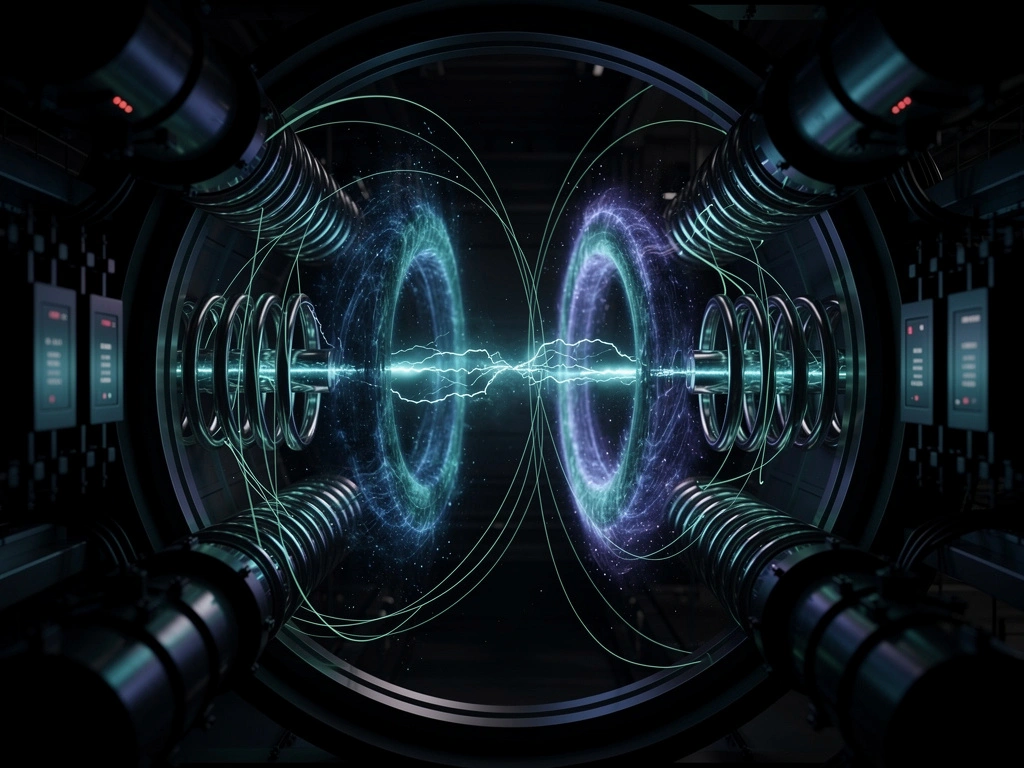
Forget the reactor as a steady-state donut of plasma. The Helion machine is a pulse-power device. It pulses, recovers energy, and pulses again, at a target rate of one cycle per second. Each cycle is a sequence of formation, acceleration, collision, compression, and electrical recovery. Drop any one stage and the architecture stops working.
Stage one is formation. At each end of a roughly 10-meter linear chamber sit two electromagnetic coils wrapped around a vacuum vessel. The team injects neutral deuterium gas into the vessel and discharges a capacitor bank into the coils at around 30 to 40 kilovolts, with current spikes in the tens of kiloamps. The pulse ionises the gas and shapes the resulting plasma into a self-confined ring with closed internal magnetic field lines: a field-reversed configuration plasmoid. Two of these form, one at each end.
Stage two accelerates the plasmoids toward each other through a series of staged compression coils, like a railgun for compact plasma rings. They meet in the middle of the machine at supersonic velocities and merge. Stage three compresses the merged plasmoid further by ramping the magnetic field around it. As the plasmoid is squeezed, its internal pressure rises, its temperature climbs into the hundred-million-degree range, and the deuterium nuclei start to fuse.
Stage four is the part that makes Helion's architecture different from every tokamak and stellarator on earth. As the fusing plasma heats, it pushes back on the surrounding magnetic field. That outward push induces a voltage on the same capacitor bank that fired the formation pulse, in the opposite direction. Helion captures that recovered voltage directly, with no thermal cycle in between. There's no steam loop. No turbine. No generator. The plasma's internal pressure does the electrical work itself, recovered through the same coils used to compress it.
The fuel cycle is what really sets the design apart on paper. Helion's target reaction is deuterium-helium-3, an aneutronic pairing that produces a proton and a helium-4 nucleus and almost no high-energy neutrons. That matters because neutrons are the part of fusion that activates structural materials, eats reactor walls, and creates radioactive waste. D-He3 was traditionally written off because helium-3 is rare and expensive on Earth. Helion's answer: run the deuterium-deuterium side reactions first, capture the tritium that comes out, let the tritium beta-decay into helium-3, and feed that back into the cycle. The reactor breeds its own fuel.
4 Trenta and the 100 Million Degree Threshold
Trenta was Helion's sixth prototype and the device that established the company's technical credibility. It ran for 16 months ending in 2021. Across that run it fired more than 10,000 plasma pulses and reported a stack of numbers that, if accurate, put Helion ahead of every other private fusion outfit on temperature-density-confinement product.
The headline numbers were ion temperatures above 100 million degrees Celsius (around 8 keV), magnetic fields exceeding 8 tesla in the compression region, ion densities up to 3×10²² per cubic meter, and confinement times reaching 0.5 milliseconds. For an FRC at that scale, none of those individual numbers is a world record on its own. The product of them is the thing that matters: the device hit a parameter regime where deuterium fuses at rates the diagnostics could resolve, with confinement long enough that the team could iterate the pulse architecture without rebuilding the machine each time.
What Trenta didn't do was produce net electricity. Helion has been clear about that on the open record. Trenta was the proof that the architecture worked at fusion conditions. Polaris is supposed to be the proof that the architecture closes the loop on the electrical recovery side. The two questions are different, and Trenta answered only the first.
5 Polaris and the D-T Surprise
Polaris is the seventh-generation machine, sitting in a 60-foot-long building in Everett. Construction started in 2021 and finished in late 2024. Initial operations began the same year. In August 2024 the Washington State Department of Health issued the facility a Large Broad Scope license, the regulatory step required to handle tritium on-site.
The 2021 marketing position was that Polaris would produce net electricity by the end of 2024. That target slipped to the end of 2025. As of December 2025 the demonstration hadn't happened. On February 13, 2026, Helion announced something different and arguably more interesting: Polaris had achieved 150 million °C ion temperatures running deuterium-tritium fusion, the first private device to demonstrate measurable D-T fusion at that temperature.
That announcement reads strange against Helion's design narrative. The whole pitch on the public record has been D-He3 aneutronic fusion. So why was Polaris running tritium? The plain explanation is that D-T is the easiest fusion reaction to demonstrate at temperature, with the largest cross-section at lower energies; running it first proved out the device's pulse architecture, diagnostics, and electrical recovery system before scaling to the harder D-He3 reaction. The less plain explanation is that the real engineering target keeps moving, and the public communication is being pulled forward to whatever milestone landed this week.
Either reading is consistent with the open record. What Polaris hasn't done as of May 2026 is put net electrical output on a meter outside the lab. The Microsoft deadline is 2028. Whether the Malaga plant comes online with Polaris-derived hardware or with a successor (Orion, the eighth-generation device, has been in design since 2022) is the next-shoe question.
6 The Microsoft Deal and Why It's Unusual
The May 10, 2023 announcement is the only one of its kind. Microsoft committed to buy 50 megawatts of fusion electricity from a Helion plant by 2028. The contract reportedly carries financial penalties if Helion doesn't deliver, terms unusual enough that MIT Technology Review's coverage at the time called the timeline "aggressive" and quoted multiple fusion physicists saying the deadline was unmeetable.
In July 2025, Helion broke ground on the plant site. Land owned by the Public Utility District operating Rock Island Dam, near Malaga in Chelan County, Washington, became the build location. The 50 MW is intended for Microsoft data centers in the same region; Constellation Energy is the contracted power marketer. S&P Global's coverage at announcement noted the plant would be "online in 2028" if Helion stayed on schedule.
Why does Microsoft care enough to sign a contract that physicists say can't be met? AI inference compute is power-bound. A hyperscaler that can lock in 50 MW of zero-carbon, zero-fuel-procurement, no-curtailment electricity at any price they negotiated in 2023 has a strategic asset that nothing in the conventional generation stack can match. If Helion delivers, the deal closes the most expensive non-recurring problem on Microsoft's data-center forecast. If Helion misses, Microsoft pays the financial penalty and gets the deal as a hedge. The downside is a rounding error against the upside.
7 Funding: The DARPA-NASA-VC Stack
Helion's funding history is a clean cross-section of how compact fusion gets capitalised in the United States in 2025. The pre-Helion baseline came from federal contracts at MSNW: roughly $7 million across DOE, DOD, and NASA between 2005 and 2012, all of it nominally for plasma propulsion research. The fusion application of the same hardware was a side benefit that the propulsion contracts didn't require the team to explain. In 2015 the Department of Energy's ARPA-E ALPHA programme awarded Helion just under $4 million under the project title "Staged Magnetic Compression of FRC Targets to Fusion Conditions," the first contract that named fusion as the explicit deliverable.
The private-capital era began in 2014 and accelerated sharply in 2021. The November 2021 Series E raised $500 million led by Sam Altman's Y Combinator network, with another $1.7 billion of milestone-tied commitments behind it. Altman became Chairman and remains the most prominent backer. The January 2025 Series F closed at $425 million on a stated $5.4 billion valuation, with Lightspeed Venture Partners, SoftBank, and the Series E participants returning. Then, on June 4, 2026, the Series G closed at $465 million on a $15.5 billion post-money valuation, led by Thrive Capital, bringing the total raised to roughly $1.5 billion. As of mid-2026, by any private-fusion metric, Helion is the most heavily capitalised company in the field.
One name is absent from that stack, and its absence is worth recording. In-Q-Tel, the CIA's venture firm, has never publicly backed Helion. A read-through of all 459 companies In-Q-Tel lists in its portfolio found no FRC company at all, and no compact-fusion company of any kind: its disclosed fusion money went to Tokamak Energy and to the tritium fuel-cycle supplier Kyoto Fusioneering. The In-Q-Tel fusion trail sets out what that does and doesn't establish, given that In-Q-Tel describes its own published list as a snapshot of 800+ investments.
8 Forbes' Reading: FRC Geometry and the Orb Signature
Ashton Forbes' interest in Helion is geometric. His argument runs through the shape of the plasma, not the company's commercial timeline. In his videos covering Kirtley's Lex Fridman interview and the Helion engineering demos, the structural claim is consistent: the MH370 orbs visible in the leaked satellite and FLIR footage carry a propulsion architecture that lives in the same family as the FRC plasmoids Helion forms in Polaris. Three plasma spheres with no visible containment structure, holding shape against atmospheric drag, executing controlled manoeuvres around an aircraft. The orbs are visible; Forbes argues their internal organisation is a scaled-up Helion.
The structural backing for Forbes' reading is that the FRC geometry does what the orbs appear to do. A field-reversed configuration is a self-confined plasma ring. Its magnetic field is generated by the plasma's own current, not by external coils, which means the structure can hold its shape without a visible container. In a Helion reactor, that shape lasts a fraction of a millisecond before compression destroys it. In a sustained-FRC propulsion application, the question is how to keep that self-confinement stable for seconds or minutes at a time. If you can, you have a luminous plasma ball that flies, with no observable structure. That's the orb.
Forbes also points at a specific Helion paper. In "Nuclear Weapons Are Disrupting UFO Flight?" (April 2025) he cites a David Kirtley paper on FRC physics that describes "large parallel electron drift velocities along the magnetic field" inside a field-reversed configuration. His framing is that those drift velocities, if you scale them up in a sustained device, look exactly like the geometry needed to produce a free-electron laser inside the plasma. The X-ray emissions Forbes claims to see along the axial line of the MH370 orbs would, in his reading, be the externally observable signature of that internal laser. Kirtley's paper is real and peer-reviewed. The interpretation is Forbes', and it goes well beyond what the paper itself claims.
On the secondary chain, Forbes argues that Lockheed Martin's compact fusion reactor, announced in 2014 and quietly walked back into a "no further announcements" status in 2018, was a copy of the FRC architecture Helion was developing publicly. The 4Orbs Charles Chase research page covers the Lockheed CFR claim in detail. Lockheed's published patent diagrams do show a compact toroid design with cusped magnetic geometry, and the company's silence after 2018 is a documented fact, not Forbes' invention. Whether the resemblance to Helion's architecture is coincidence, parallel development, or institutional copying is a question the open record can't settle.
We've laid out Forbes' framing on its own terms. The claim that Helion's geometry is the propulsion lineage behind the MH370 orbs is structural, not direct: a recognisable shape of physics that lives in both places, with no documented engineering bridge between them. Treat that as the open question it is. The compact fusion line is real. So is the orb footage. The link between them is what Forbes is arguing, and what mainstream plasma physicists haven't engaged with on the public record.
9 The MARAUDER Backdrop
One reason Forbes' lineage argument carries any weight at all is that the Air Force was building plasmoid weapons in the early 1990s. The programme was called MARAUDER, an acronym for Magnetically Accelerated Ring to Achieve Ultra-high Directed Energy and Radiation. Computer simulations started in 1990. The first published experiment ran on August 1, 1993, at the Air Force Research Laboratory. The device accelerated 1 to 2 milligrams of plasma at up to 100 billion g through a 1-meter coaxial railgun, producing toroidal plasma rings.
MARAUDER drew on RACE, the Ring Accelerator Experiment, which ran at Lawrence Livermore National Laboratory in 1991. Both programmes worked the same physics: form a compact toroidal plasma, accelerate it through a magnetic gun, deliver the kinetic energy on target. The published literature stops in the mid-1990s. Whether the work continued under a different programme name or was wound down for engineering reasons isn't something the open record makes available.
What this means for the Helion lineage is narrower than it sounds. MARAUDER worked on accelerated plasmoids, not on sustained-FRC reactors. The shared physics is the formation and confinement of compact toroids; the application diverges. But the Air Force's interest in compact plasma rings as weapons predates Helion's commercial work by two decades, and the public literature on what came of MARAUDER is thinner than what's available on contemporary tokamak research. The gap is real, and it's part of the framing for why a private FRC company in 2026 isn't operating in a vacuum that started in 2013.
10 Open Questions
- Will Polaris produce net electricity before the Microsoft deadline? The 2021 target slipped to 2025 and then slipped again. The February 2026 D-T announcement was a temperature record, not an electrical-recovery demonstration. The 2028 deadline still has runway, but every quarter without a net-electricity announcement narrows the credibility of the timeline.
- Why did Polaris run D-T instead of the design-target D-He3? The plain physics answer (D-T is easier at temperature) is reasonable. The pattern, where the public-facing milestone shifts to whatever the device can do this week, is worth tracking. Helion's communication discipline on this question over the next 18 months is a useful signal.
- Is the Lockheed CFR design materially derived from FRC work in the open private fusion community? Forbes argues yes; the open record shows an architectural family resemblance but no documented engineering bridge. Lockheed's 2018 silence on the CFR is itself a data point, and whatever caused it sits behind a wall the public record doesn't penetrate.
- What's the link, if any, between MARAUDER-era compact-toroid weapons research and contemporary FRC reactor work? The shared physics is documented. The personnel and programmatic continuity isn't. A FOIA targeting the AFRL archives on MARAUDER's wind-down would help calibrate whether the silence after 1995 reflects programme termination or continuation under a different name.
- Has any independent plasma physicist tested Forbes' specific structural claim that the MH370 orb geometry is consistent with a sustained-FRC propulsion device? The 4Orbs review is that nobody has, on the public record. Forbes makes the argument; mainstream plasma physicists don't engage with it. That gap is one this site would like to see closed.