Cold Fusion & LENR
The forbidden reaction
In Plain English
In 1989, two electrochemists, Martin Fleischmann and Stanley Pons, announced they had achieved nuclear fusion at room temperature in a tabletop apparatus. The claim was met with intense skepticism because conventional fusion requires temperatures exceeding 100 million degrees Celsius. Most attempts to replicate their results failed in the first months, and "cold fusion" became a career-ending term in mainstream science.
But here's the thing: it didn't go away. Over the next 30 years, more than 1,000 experiments reported anomalous excess heat: energy output far beyond what any chemical reaction could explain. The U.S. Navy's SPAWAR laboratory (Space and Naval Warfare Systems Center) replicated the results multiple times over a decade of work. The debate shifted from "does it happen?" to "what's the mechanism?"
The field rebranded as LENR (Low Energy Nuclear Reactions) to distance itself from the stigma. The fundamental question remains unanswered: if the Coulomb barrier makes room-temperature fusion physically impossible, what is producing all this excess heat? Understanding why mainstream physics says it can't work requires understanding how fusion actually works.
Hot Fusion vs. LENR
Conventional fusion overcomes the Coulomb barrier with extreme heat. LENR claims nuclear reactions occur within a metal lattice at room temperature, an observation that defies accepted physics but has been reported over 1,000 times.
How It Works
The Fleischmann-Pons Experiment
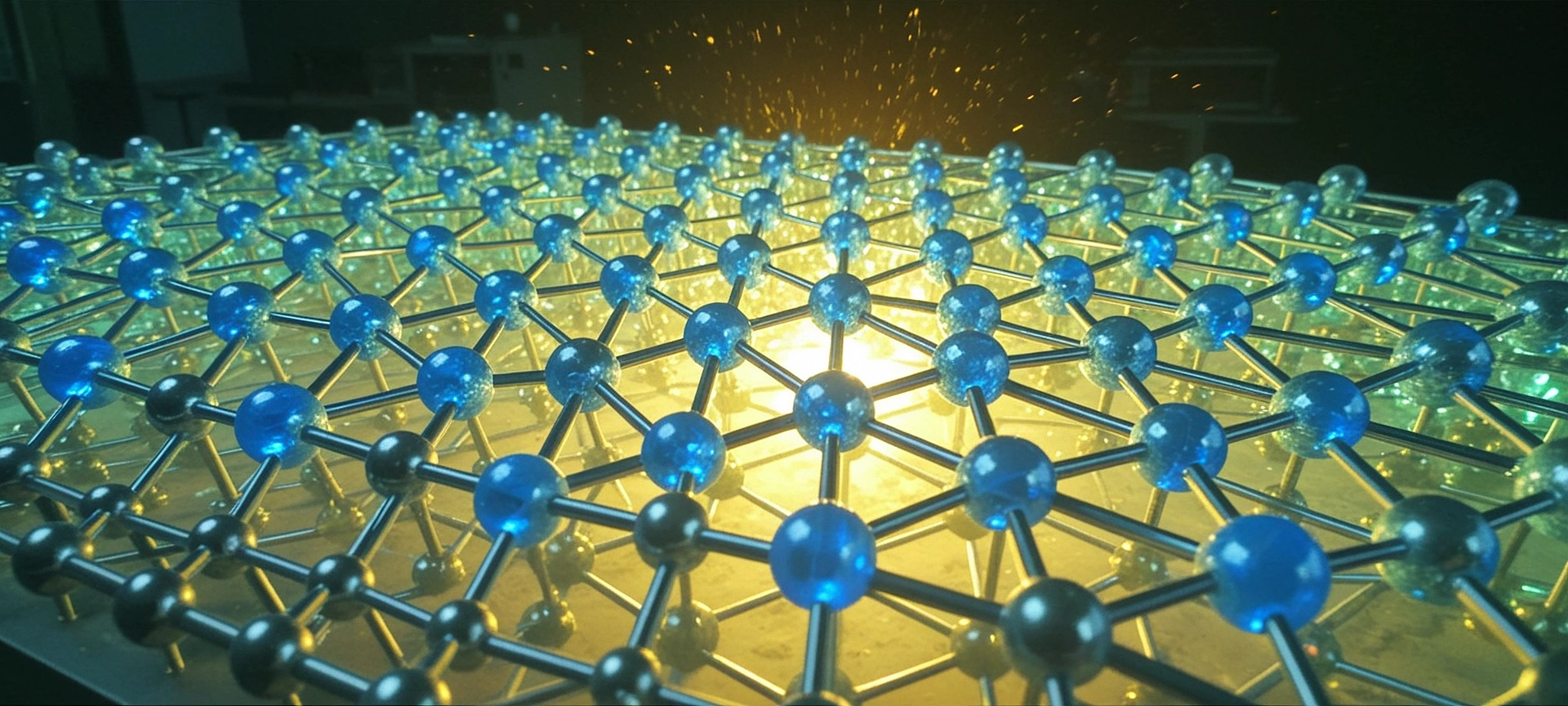
The setup was deceptively simple: a palladium electrode immersed in heavy water (D₂O: water where hydrogen is replaced by deuterium). Run an electric current through it. The electrolysis forces deuterium atoms into the palladium metal's crystalline lattice structure, packing them in at extremely high densities, approaching a 1:1 ratio of deuterium to palladium atoms.
After days or weeks of loading, some experiments reported results that couldn't be explained by chemistry:
Excess heat: energy output far beyond any possible chemical energy stored in the system. Some experiments reported watts of excess power sustained for days, with total energy output exceeding input by factors of 10 or more.
Helium-4: trace amounts of helium-4 (a fusion byproduct) were detected in some experiments, correlated with the excess heat measurements. This is a nuclear signature; chemistry doesn't produce helium.
Low-level nuclear emissions: some experiments detected tritium, neutrons, or charged particles at levels above background, though far below what conventional D-D fusion would predict.
The key controversy: these results were inconsistent. Not every experiment worked. Nobody could explain how nuclei were fusing without extreme temperature. And the nuclear products didn't match what conventional fusion theory predicted: too much heat, not enough radiation. This inconsistency became the primary argument against the claims.
Why Mainstream Physics Says It's Impossible
The Coulomb barrier is the central objection. Every atomic nucleus carries a positive electric charge. To fuse, two nuclei must get within approximately 1 femtometer (10−15 meters) of each other, close enough for the strong nuclear force to grab them. But the electromagnetic repulsion between two positive charges increases dramatically as they approach, creating an energy barrier that requires extreme kinetic energy (i.e., extreme temperature) to overcome.
At room temperature, nuclei simply don't have enough kinetic energy to get anywhere close to the barrier. Even quantum tunneling, the quantum mechanical effect that allows particles to "tunnel" through energy barriers they classically shouldn't be able to cross, is statistically negligible for D-D fusion at these energies. The probability is so vanishingly small that you'd need to wait longer than the age of the universe to see a single fusion event.
There is no accepted theoretical framework for how a metal lattice could catalyze nuclear reactions. Palladium's electron cloud doesn't significantly screen the Coulomb barrier. The crystal lattice spacing is orders of magnitude larger than the femtometer scale needed for nuclear interactions. And the inconsistency of results (sometimes it works, sometimes it doesn't, with no clear pattern) undermines reproducibility, which is a bedrock of science.
Why It Won't Go Away
Despite the theoretical objections, the experimental evidence keeps accumulating. The U.S. Navy's SPAWAR (Space and Naval Warfare Systems Center) confirmed excess heat and nuclear signatures (including detection of energetic charged particles using CR-39 nuclear track detectors) over more than a decade of carefully controlled experiments. These weren't fringe researchers; this was a major U.S. military laboratory.
The 2004 Department of Energy review panel was split down the middle. Half the panel found the evidence "not conclusive," but the other half said it warranted further investigation. This was a significant shift from the 1989 DoE panel, which had rejected cold fusion outright.
Google funded a $10 million LENR research program (2015–2019) through university labs at MIT, the University of British Columbia, and the University of Maryland. The team didn't find cold fusion, but they concluded the field deserved serious study and published their results in Nature in 2019, one of the most prestigious scientific journals in the world.
In Japan, Mitsubishi Heavy Industries reported transmutation of elements in palladium-deuterium systems, one element turning into another, which is by definition a nuclear process. Multiple Japanese government agencies have funded LENR research.
The lattice confinement hypothesis suggests that the crystalline structure of metals may create conditions that enhance tunneling probability: through electron screening, coherent multi-body interactions, or other mechanisms not captured by simple two-body Coulomb calculations. It's not proven, but it's not disproven either. NASA published a lattice confinement fusion paper in 2020 showing enhanced fusion rates in an erbium lattice, though under different conditions than the original Fleischmann-Pons experiment.
Why This Matters for 4Orbs
Ashton Forbes argues that if LENR is real, it represents a compact, room-temperature nuclear energy source: exactly the kind of technology that could power the orbs. Unlike conventional fusion, which requires massive confinement systems and extreme temperatures, LENR (if genuine) would need only a metal lattice and hydrogen isotopes. That's a power source that could fit inside a small device.
The pattern of institutional rejection mirrors the broader narrative of energy technology suppression. Cold fusion was declared dead within months of its announcement, despite positive experimental results continuing to accumulate for decades. Researchers who pursued LENR were denied funding, refused publication, and in some cases lost their academic positions. If the effect is real, the suppression is one of the most consequential cases of scientific gatekeeping in modern history.
If the palladium lattice creates conditions for low-energy nuclear reactions, it's plausible that more advanced configurations (engineered metamaterials, structured lattices, optimized isotope loading) could achieve even higher energy densities. The gap between "anomalous excess heat in a lab" and "power source for advanced technology" is large, but the underlying physics would be the same.
The Navy's involvement through SPAWAR is particularly significant given the broader pattern of Navy-linked advanced technology research. The Navy funded SPAWAR's LENR work, funded Bussard's Polywell fusion reactor, and is associated with the Salvatore Pais patents for "compact fusion reactors" and "inertial mass reduction devices." Whether these threads are connected or coincidental is an open question.
Mainstream vs. Speculative
This site covers both established science and unproven claims. Here's where the line falls for this topic.
The Fleischmann-Pons experiment occurred. Anomalous excess heat has been reported in many experiments across multiple laboratories and countries. The Coulomb barrier is real and well-understood physics. Mainstream physics has no accepted mechanism for room-temperature nuclear fusion. The 2004 DoE panel was genuinely split on whether the evidence warranted further study.
That LENR is a genuine nuclear process rather than measurement error or unaccounted-for chemical effects. That lattice confinement enables nuclear reactions at room temperature. That LENR has been deliberately suppressed to protect existing energy industries. That the orbs use LENR-type energy generation. These claims range from "plausible but unproven" to "highly speculative."
Key Terms
Cold Fusion
The original term for nuclear fusion occurring at or near room temperature, as claimed by Fleischmann and Pons in 1989. Now largely replaced by "LENR" in the research community due to the stigma attached to the original term.
LENR
Low Energy Nuclear Reactions. The rebranded term for cold fusion research, encompassing any nuclear reaction that occurs at energies far below what conventional nuclear physics predicts is necessary. Includes anomalous heat, transmutation, and low-level nuclear emissions.
Palladium Lattice
The crystalline structure of palladium metal, which can absorb up to 900 times its own volume in hydrogen. In LENR experiments, deuterium is loaded into this lattice at high density. Nickel lattices are also used in some LENR configurations.
Deuterium
A hydrogen isotope with one proton and one neutron (ordinary hydrogen has no neutron). Occurs naturally in about 1 in 6,400 hydrogen atoms. Used as the fuel in most LENR experiments, typically in the form of heavy water (D₂O).
Excess Heat
Energy output that exceeds all known chemical energy sources in the experimental system. The central claim of LENR research. Measured using calorimetry. Some experiments report energy output 10–100x greater than electrical input.
Coulomb Barrier (at low energy)
The electromagnetic repulsion between positively charged nuclei that prevents them from getting close enough to fuse. At room temperature, the barrier is effectively insurmountable by conventional physics; this is the core theoretical objection to LENR.
SPAWAR
Space and Naval Warfare Systems Center, a major U.S. Navy research laboratory. Their LENR research team, led by Pamela Mosier-Boss, published multiple peer-reviewed papers confirming excess heat and nuclear particle tracks using CR-39 detectors.
Lattice Confinement
The hypothesis that a metal's crystalline lattice structure creates conditions that enhance quantum tunneling probability for nuclear reactions. Proposed mechanisms include electron screening, coherent oscillations, and multi-body quantum effects. Not proven but actively researched.