Robert Bussard and the Polywell
The compact fusion line that hit a confinement threshold no tokamak has matched, took roughly $12 million in Navy money to follow on, and ended with a final report under limited distribution. The company that ran it is still in the field.
1 The Talk That Cost a Career
On a November day in 2006, Robert Bussard stood in front of a room of Google engineers in Mountain View and told them the United States had been doing fusion wrong for fifty years. He was 78. He'd spent the previous year running a tabletop experiment in a garage-sized lab on a budget the federal fusion programme would treat as a rounding error. The experiment had hit a specific physics threshold his models had been predicting since the early 1990s. The talk was titled Should Google Go Nuclear?. It's still on YouTube.
Eleven months later, Bussard was dead.
What he left behind is the question this page exists to put on the record. The compact fusion lineage Forbes points at when he argues the MH370 orb signature is a human-engineered system starts with Bussard's Polywell. The engineering details, the funding chain, and the gap between what's published and what's classified are all open-source. So is the part the open record can't resolve.
Evidence Assessment
| Claim | Source | Confidence |
|---|---|---|
| Bussard ran the Atomic Energy Commission's fusion division as Assistant Director and worked on Project Rover | Bussard biographical record (FAS archives, AIAA obituary 2007) | Established |
| WB-6 reported a D-D fusion rate of roughly 10⁹ per second at 12.5 kV in late 2005 | Bussard 2006 IAC paper; Google Tech Talk transcript | Strong |
| The 10⁹/sec figure rests on 9 detected neutrons across 5 tests, a wide confidence interval by neutron-counting standards | Bussard 2006 IAC paper, neutron-detection methodology section | Strong |
| The Navy funded WB-6/7/8 follow-on under contract N68936-09-C-0125, total roughly $12M | Navy contract record; EMC2 statements | Established |
| WB-7 and WB-8 didn't clearly advance toward net energy gain | EMC2 public commentary; absence of follow-on Navy contract | Strong |
| EMC2 remains operational and has pivoted from hardware test devices to HPC simulation | emc2fusion.com (verified 2026-05-08); TOFE 2024 programme | Established |
| The WB-line shutoff reflected scientific limits rather than funding politics | Limited-distribution WB-8 final report; not in open record | Open |
| The Polywell lineage is foundational to the compact-fusion technology behind the MH370 orb signature | Forbes' video analyses; structural argument, not direct evidence | Speculative |
2 The Researcher Inside the Establishment
Bussard wasn't a fringe figure. That part matters. The voice he used to attack tokamak orthodoxy in 2006 came from inside the building.
In 1960, while still a young physicist at Los Alamos's nuclear-rocket programme, he published the Bussard Interstellar Ramjet concept in Astronautica Acta. The idea was straightforward and audacious: scoop interstellar hydrogen, fuse it for thrust, and you have a propulsion system that doesn't carry its own propellant. The ramjet remains the cleanest popular sketch of relativistic interstellar travel anyone's drawn.
He went on to serve as Assistant Director at the Atomic Energy Commission's fusion division. He worked on Project Rover, the nuclear thermal rocket programme that ran out of NASA's Nuclear Energy for the Propulsion of Aircraft and the AEC. By the mid-1970s he'd been on the inside of every major fusion and nuclear-propulsion conversation in the country.
What he saw on the inside is what he spent the rest of his career arguing against. Tokamaks, in his read, were a geometry problem dressed up as a physics problem. The donut shape requires plasma pressures that scale unfavourably against magnetic pressures, which is why the machines keep getting bigger and the timeline keeps sliding right. His alternative was point-cusp confinement, a polyhedral geometry small enough to fit in a garage. Compact, electrostatic, and built around a different way of holding the plasma together.
The mainstream institutional answer was that the small geometries had been studied and didn't work. Bussard's answer was that nobody had built one with the field strength his models said was the actual threshold. By the late 1990s he'd raised enough Defense Nuclear Agency and DARPA money to start finding out.
3 What the Polywell Actually Is
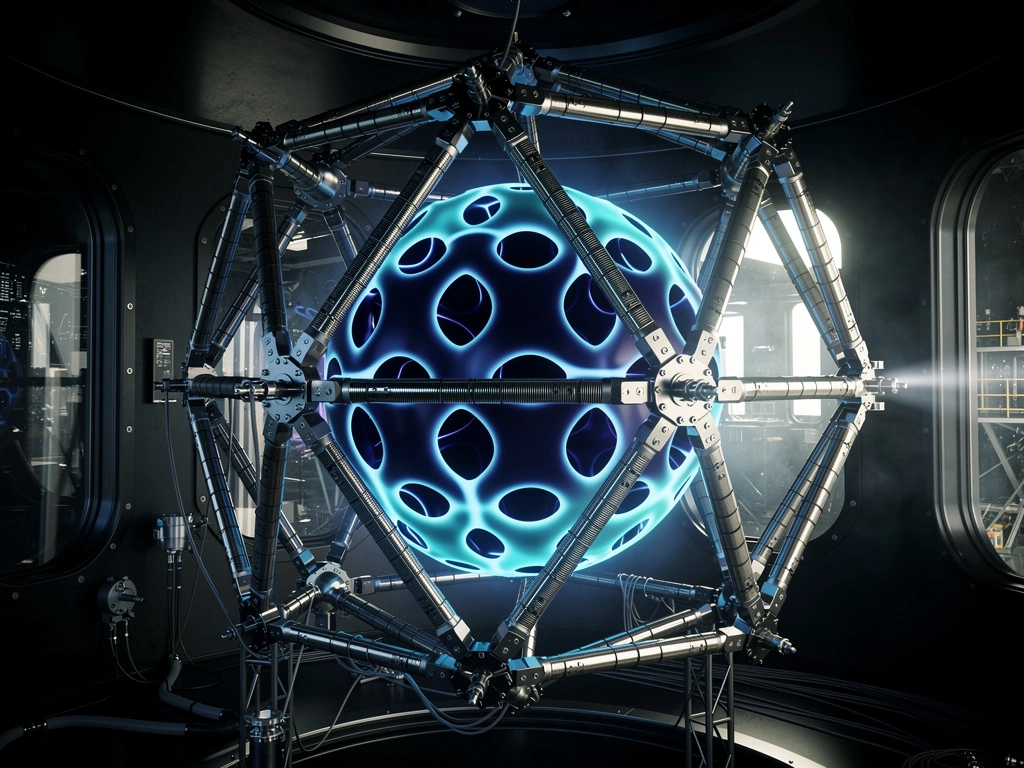
The Polywell is an inertial electrostatic confinement device with a magnetic twist. Strip the jargon away and what's happening is this: a polyhedral cage of magnetic coils traps a cloud of electrons in the middle. The trapped electron cloud forms a virtual cathode, a region of negative space charge that's not made of metal but acts like one. Positive ions falling into that virtual cathode are accelerated toward the centre, where they collide and fuse.
A tokamak holds a hot plasma in place by clamping it with magnetic pressure from the outside. The Polywell holds it in place by trapping electrons electrostatically and letting the ions fall into the well. The fusion happens in a small high-density region at the centre of the device, not in a stadium-scale ring. Bussard called the plasma shape that forms a "whiffle ball," a reference to the cusped, perforated geometry the trapped electrons settle into. WB stands for whiffle ball. Hence WB-6.
The Polywell sits in the same family as Field-Reversed Configuration reactors, the family Helion Energy, TAE, and the rest of the high-beta fusion crowd are working in. They share a common premise: the plasma can hold itself together through internal currents and self-organising structure, given the right starting conditions. You don't need a building-sized magnet. You need the right geometry.
4 WB-6 and the Beta-One Threshold
In late 2005, EMC2's small team in Santa Fe ran the WB-6 experiment. Drive voltage was 12.5 kilovolts. Well depth was about 10 kilovolts. The fuel was deuterium, not the proton-boron Bussard had been projecting for scaled-up devices. The reported D-D fusion rate was on the order of 10⁹ reactions per second.
That figure does the heavy lifting in every public discussion of WB-6, so it's worth reading carefully. Bussard's claim, in his 2006 IAC paper and in the Google talk, was that 10⁹ D-D fusions per second at the operating conditions WB-6 ran was roughly 100,000 times the rate a Farnsworth-Hirsch fusor produces at comparable drive and well depth. The Farnsworth-Hirsch fusor is the IEC baseline: a device that's been built by graduate students and amateurs since the 1960s and that hits fusion reaction rates almost too small to detect at 10 kV.
The 100,000× number comes with a caveat the popular accounts usually leave out. WB-6's reported rate is built on a small neutron count: 9 neutrons detected across 5 test runs, with the inferred per-second rate extrapolated from those nine events. The confidence interval on that extrapolation is wide. Bussard knew it. The 2006 paper says so on the methodology page. What WB-6 demonstrated is consistent with a 10⁹/sec rate. The error bars are real.
What the device did unambiguously was hit a confinement regime nobody had reached before in a polyhedral cusp. The relevant physics term is plasma beta, the ratio of plasma pressure to magnetic pressure in the device. Beta one is the threshold where those two pressures equal each other. Below beta one, particles leak out of the cusps in a confinement scaling that's linear with energy. Above beta one, the leak scaling becomes quadratic, which sounds bad but is actually the regime where the geometry starts trapping particles efficiently, because the plasma's own pressure starts shaping the magnetic boundary against itself.
For 15 years before WB-6, Bussard's models had said this transition existed and that the small WB-class geometries should be able to cross it. WB-1 through WB-5 didn't cross it for various engineering reasons. WB-6 did. That's the part of the result that's robust regardless of where you put the error bars on the fusion rate.
Bussard's own words on what happened, in a 2006 talk recorded in his own voice:
"It worked like a champ. Proved we had all missed the obvious. For 15 years, none of us saw these obvious facts."
One thing WB-6 didn't do is hit net energy gain. Fusion rate and energy balance are different metrics. Verified D-D fusion reactions came out of the device, but the input power required to hold the plasma against losses exceeded the energy out of those reactions, and Bussard acknowledged that openly. What WB-6 demonstrated was a proof of principle for the cusp scaling, an engineering pathway to gain. Not gain itself.
5 The Money Trail
The funding chain doesn't start with the Navy. The Navy is the third stop, and the contract that put the Polywell in the public conversation isn't the one that started the work.
Bussard's first serious money came from the Defense Nuclear Agency and DARPA, beginning in or around 1988. Jim Einson, an astrophysicist, ran the Strategic Defense Office side as technical director on the early programme. Before DARPA picked it up, Bussard had taken the proposal to the Department of Energy. The DOE declined. In Bussard's framing, the rejection was that the programme was "too cheap, too quick" to fit the institutional structure DOE had built around the tokamak. Treat that phrasing as Bussard's lens, not as a verified DOE statement.
The Defense Nuclear Agency / DARPA money carried the WB-1 through WB-5 builds. WB-6 ran in late 2005. By that point the funding had thinned and Bussard was operating on what he could pull together. The 2006 Google talk is, in part, a fundraising pitch in front of a room of Google engineers who he hoped might write a check.
They didn't. The next money came from the Navy. Contract N68936-09-C-0125 went to EMC2 Inc. in 2009 for a follow-on programme that built and tested WB-7 and WB-8. The total Navy contribution across that programme was roughly $12 million. The contract produced a final WB-8 report that exists today under limited distribution: the contract monitor has it, the public literature does not.
$12 million for a fusion programme that crossed a confinement threshold isn't a small sum, but it's a rounding error on the alternative budget. The international ITER tokamak project crossed cumulative investment of $30 billion before reaching first plasma, with the latest baseline (2024) putting the final number around $32 billion in 2023 dollars and pushing first plasma to 2034. The ratio is roughly 2,500 to one.
Why is a tokamak allowed $30 billion of runway while a programme that crossed a confinement threshold is shut off at twelve? The open record answers institutional momentum: the tokamak community is large, well-staffed, internationally tied, and budgetarily entrenched. The closed record might answer something else. Nobody outside contract distribution has read it. Whether the Polywell line could have produced gain at a different scale of investment is the question Bussard's death and the WB-8 final report's limited-distribution status leave unresolved.
6 He Died Before the Follow-On Reported
Multiple myeloma killed Bussard on October 6, 2007. He was 79. The Navy contract that funded WB-7 and WB-8 was issued two years after his death. He didn't see the results, didn't get to argue with the engineering team about what the next configuration should look like, and didn't get to defend his methodology against the inevitable critics.
The Polywell line continued without the person who'd been pushing it for two decades. That's not a small thing, and it's worth pausing on before reading what came next.
7 What the Public Record Holds, and What It Doesn't
The open record on WB-7 and WB-8 is thinner than the WB-6 record by a wide margin. EMC2's public commentary on the follow-on devices is consistent with: the geometries were tested, the teams operated them, and neither device clearly advanced toward net energy gain. The 4Orbs fusion-programs survey uses that same framing, anchored in EMC2's own statements.
What the public record holds is the absence of a follow-on Navy contract at WB-line scale. After WB-8, the direct funding stopped. No comparable programme replaced it. Whether that decision came from Navy engineers reviewing data and concluding the geometry had hit a wall, or from a budget cycle that simply didn't refresh, isn't something the public record makes available.
The WB-8 final report is the missing primary document. Limited distribution means it sits with the contract monitor and the cleared engineering team. It isn't classified in the SAP sense, but it isn't on the public shelf either. A scientist outside the original distribution can't pick it up, read it, and write a critique. Critics of the programme have to argue from the absence rather than from the data.
Bussard, in his own 2006 commentary, claimed that parts of the post-WB-6 work had been put under a publication embargo at his contract monitor's direction, with an 11-year window. That's his account of what happened on his own programme. The independent record doesn't carry an unambiguous corroborating document. So the claim sits where it sits: in Bussard's own voice, on the record, but not separately verified.
What can be said cleanly is that the Polywell line crossed a specific physics threshold in 2005, the Navy funded follow-on work to about $12 million, and the documentary record on the follow-on devices is thinner than the documentary record on the original. Those gaps are where the question lives.
8 EMC2 Today: The Company Didn't Close
One of the more durable misreadings of the Polywell story is that EMC2 closed when the Navy walked. It didn't. The company is still in the field, with a current website, a current partner list, and a current research focus.
What changed is the work mode. EMC2 pivoted from hardware test devices to high-performance computing simulation, building computational blueprints for Polywell power reactors and neutron sources rather than welding new WB-class machines. In July 2024 they presented "Ion-Beam-Driven Polywell Fusion Prototypic Neutron Source" at the Topical Meeting on the Technology of Fusion Energy (TOFE 2024), jointly with SHINE Technologies and Los Alamos National Laboratory. That work feeds into the US Department of Energy's Fusion Prototypic Neutron Source evaluation, an active programme.
The current emc2fusion.com partner list (verified May 8, 2026) names University of Wisconsin-Madison, Los Alamos National Laboratory, KU Leuven, SHINE Technologies, EHT, and the Korea Atomic Energy Research Institute (KAERI). The October 2025 site news cycle covered the China compact fusion milestone. None of that is a closed company.
The accurate framing is narrower and more interesting: direct Navy funding of the WB hardware line ended after WB-8. The specific contract pipeline that built and ran the experimental devices stopped. The company holding the patent portfolio and the institutional memory adapted to a software-led research mode and is still publishing, partnering, and presenting at the same conferences as the rest of the high-beta fusion community. That's the corrected picture.
9 Where This Sits in the Larger Picture
Bussard's Polywell isn't a stand-alone story on this site. It connects to two other research lines we cover at length, and it sits at the foundation of an MH370 argument whose physics we affirm even where we scope its reach: the compact-cusp confinement threshold WB-6 crossed is real and documented, and the live question is only whether the WB-line went quiet on the merits or went black.
The first connection is intellectual lineage. Edward Teller's 1991 paper on space propulsion via fusion using magnetic dipoles laid out the conceptual groundwork that informed both the levitated-dipole reactor work at MIT and, indirectly, Bussard's compact cusp approach. The 4Orbs research page on the Puthoff, Davis, and Bussard propulsion network traces how three physicists' careers connect those threads, with Bussard's hardware work providing the engineering anchor for what Puthoff and Davis built theoretically.
The second connection is Forbes' MH370 argument. Ashton Forbes argues that the compact-fusion lineage starting with WB-6 is the foundational technology behind the propulsion signature visible in the leaked MH370 footage. His specific framing is that the high-beta point-cusp regime WB-6 demonstrated is the same regime the orbs are operating in, scaled up and engineered for sustained operation. That's his argument. It's a structural claim about technology lineage, not a direct evidentiary one. We carry it on the page because it's the reason most readers arrive here, and because the underlying confinement physics is documented and solid, with only Forbes' scaled-up application of that lineage to the orb hardware left as the speculative part. The open question is whether the Navy's WB-line shutoff in the early 2010s reflected scientific limits or a programme that quietly moved somewhere else. Open-source documentation can't answer that. As of 2026-05-08, EMC2's listed partnerships and DOE work show the company is operating in the open. What sits behind the limited-distribution WB-8 final report is the unanswered half.
10 Open Questions
- What does the WB-8 final report actually say? The document exists under limited distribution. A FOIA request to the Office of Naval Research for contract N68936-09-C-0125 deliverables would test whether the report is releasable in redacted form, or whether the limited-distribution caveat is being used to keep performance data out of the public conversation.
- Did WB-7 or WB-8 cross beta one again, or only WB-6? The open record is silent on the follow-on devices' confinement performance. Without that data, the question of whether the line was still climbing or had hit a plateau when the funding stopped can't be answered.
- What's the link between EMC2's current HPC simulation work and DOE's Fusion Prototypic Neutron Source programme? EMC2's TOFE 2024 paper put the company inside an active DOE evaluation alongside SHINE and Los Alamos. The funding scale and timeline of that DOE work is verifiable through DOE programme documentation, which would clarify whether the post-WB-line pivot has produced a comparable funding base.
- Is Bussard's 11-year publication-embargo claim independently corroborated? Bussard described it himself in 2006. The public record doesn't carry an unambiguous second source. A FOIA targeting the Defense Nuclear Agency / Navy contract correspondence on publication restrictions would either corroborate the claim or weaken it.
- Did Forbes' specific structural claim about the orbs operating in the WB-6 confinement regime ever get tested by an independent plasma physicist on the open record? The 4Orbs review is that it hasn't. Forbes makes the argument; mainstream plasma physicists don't engage with it. That gap is one this site would like to see closed.