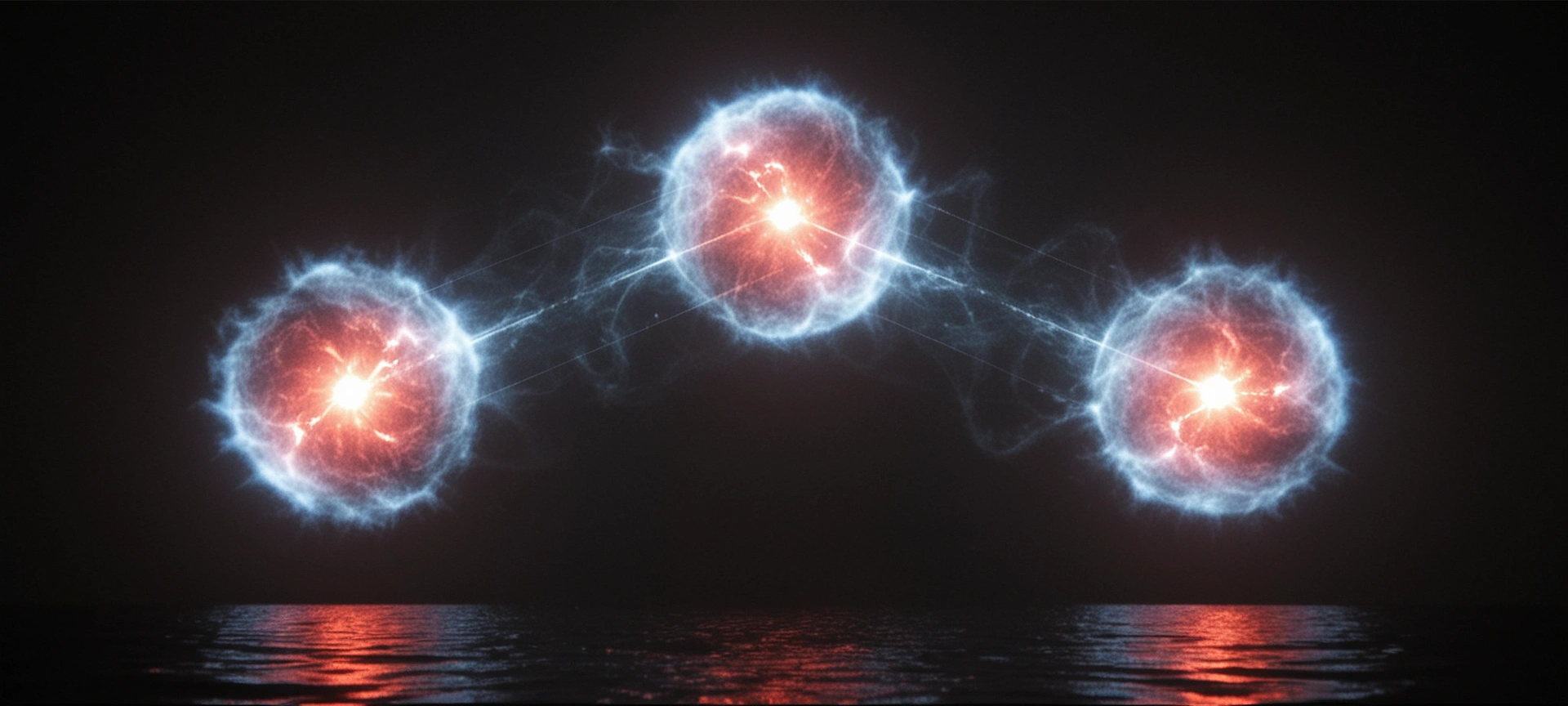
MH370 Orbs Explained
A physics analysis
In Plain English
This is the guide where everything comes together. You've learned about plasma, plasmoids, fusion, zero-point energy, negative energy, spacetime curvature, and magnetic confinement. Now ask the question: IF the objects in the MH370 footage are real technology (not CGI, not artifacts), what physics would be required?
This isn't about proving they're real; it's about asking what known (and frontier) physics would need to be true for them to exist. Ashton Forbes' central thesis is that these aren't mysterious alien devices; they're the product of breakthrough physics that humans could theoretically achieve, much of which has been researched by the U.S. military.
Every piece of physics in this analysis has a foundation in real research. The question is whether these separate threads have been combined into a working device.
Physics Breakdown
The four frontier physics concepts that would need to be integrated into a single device for the MH370 orbs to function as observed in the footage. Each connects to a 101 guide you can explore in depth.
How It Works
The Energy Problem
The orbs in the footage appear to sustain continuous, high-energy operation: maintaining plasma containment, producing thrust, and maneuvering at high speed for extended periods. Chemical fuel can't do this: the energy density is too low for the apparent size of the objects. Nuclear fission could, but produces radiation signatures and requires heavy shielding.
This leaves two candidates:
Compact Fusion
Possibly aneutronic p-B11, using FRC or Polywell geometry. This is what the Navy's Pais patents describe: a compact fusion reactor small enough to fit inside an aircraft or autonomous vehicle.
Zero-Point Energy
If possible, ZPE extraction would provide virtually unlimited energy with no fuel at all. The quantum vacuum contains enormous energy density; the challenge is extracting it in a usable form.
Either would represent a classified breakthrough of historic proportions.
Learn more: How Fusion Works 101 explains the D-T reaction, the Coulomb barrier, and why compact reactors matter. Zero-Point Energy 101 covers the quantum vacuum and the Casimir Effect.
The Containment Problem
The orbs appear as stable, self-luminous spheres, consistent with a plasmoid (a self-contained plasma structure held together by its own magnetic fields). Field-Reversed Configuration (FRC) plasmoids are one of the most stable plasma configurations known to physics.
The key insight from the footage: the orbs maintain their shape while maneuvering at high speed, suggesting extremely robust magnetic confinement. This matches the behavior of computational FRC simulations: a plasma structure whose internal magnetic fields are strong enough to hold it together under extreme conditions.
Ball lightning, a naturally occurring plasmoid, demonstrates that plasma can self-organize into stable spherical structures, though the mechanism isn't fully understood. The orbs in the footage behave like an engineered version of this natural phenomenon: brighter, more stable, and far more energetic.
Learn more: Plasmoid 101 explains how plasma self-organizes into stable structures. Magnetic Confinement 101 covers FRC geometry and why it achieves near-unity beta.
The Propulsion Problem
The orbs appear to change direction instantaneously: no banking, no visible exhaust, no deceleration-then-reacceleration. In conventional physics, this is impossible. Newton's third law requires a reaction: to push something forward, something else must be pushed backward. Every rocket, jet engine, and propeller works this way.
But if the orbs manipulate spacetime locally, like a miniature Alcubierre bubble, the object inside doesn't experience acceleration at all. It sits in flat spacetime while space itself moves around it. Compressed in front, expanded behind. The object is stationary relative to its local spacetime: it's the geometry that changes.
This would require negative energy (see Negative Energy 101). The Pais patents explicitly describe "engineered spacetime modification" using rotating electromagnetic fields, a mechanism that, if it worked, would produce exactly the kind of reactionless propulsion seen in the footage.
Learn more: Spacetime Curvature 101 explains how mass warps the fabric of spacetime. Negative Energy 101 covers the Casimir Effect and why the Alcubierre metric requires exotic matter.
The Coordination Problem
Three orbs move in apparent coordination: maintaining formation, adjusting to the aircraft's movements, eventually converging. This requires some form of communication or shared information between the three objects.
Three possibilities:
1. Classical Communication
Radio or optical signals between the orbs. Straightforward, but these would be detectable by military sensors, and no such signals have been reported.
2. Pre-Programmed Trajectories
The orbs follow a scripted flight path. But they appear to react to the aircraft's movements in real time, which would require adaptive behavior, not a fixed program.
3. Quantum-Correlated Behavior
The ER=EPR conjecture suggests entangled particles may share a wormhole connection. If the orbs were created from a common quantum state, they might share instantaneous correlations. This is the most speculative element of the analysis.
Learn more: Entanglement & Wormholes 101 explains quantum entanglement, the EPR paradox, and the ER=EPR conjecture.
Why This Matters for 4Orbs
This page is the Rosetta Stone of the 101 series. The entire investigation rests on a simple question: is the technology shown in the MH370 footage physically possible?
The answer, based on published physics research, is: yes, each individual component has a basis in real science. Plasma physics is established. FRC plasmoids exist in laboratories. The Alcubierre metric is a valid solution to Einstein's field equations. The Casimir Effect produces measurable negative energy density. Quantum entanglement has been experimentally confirmed and earned a Nobel Prize.
The question is whether these separate threads have been integrated into a working device, and whether this has been achieved in classified military programs.
The Navy patents filed by Salvatore Pais describe a device that integrates exactly these capabilities: a compact fusion reactor powering a rotating electromagnetic field that modifies local spacetime geometry, all contained within a craft capable of transmedium operation. The fact that these patents exist as public documents is perhaps the most concrete evidence that this research direction is taken seriously at the highest levels.
Detailed footage analysis and evidence breakdown
Advanced propulsion concepts and the Pais patents
The specific machine behind the compact-fusion orb claim, and what would have to be true for an orb to be one
Start from the beginning with plasma, confinement, and fusion
Mainstream vs. Speculative
This site covers both established science and unproven claims. Here's where the line falls for this topic.
Plasma physics is well-established science. FRC plasmoids exist in laboratories and are actively researched by companies like TAE Technologies.
The Alcubierre metric is a valid solution to Einstein's general relativity field equations.
The Casimir Effect produces measurable negative energy density, experimentally confirmed.
Quantum entanglement is proven and earned the 2022 Nobel Prize in Physics.
The Navy patents filed by Salvatore Pais are real, publicly available documents.
That these separate physics concepts have been integrated into a working device.
That the MH370 footage shows real technology (not CGI).
That the U.S. military has achieved breakthrough propulsion.
That the orbs demonstrate spacetime manipulation.
That quantum entanglement enables macro-scale coordination between physical objects.
Key Terms
Plasmoid
A self-contained plasma structure held together by its own magnetic fields. Ball lightning is a natural example. FRC plasmoids are the most stable known configuration.
Field-Reversed Configuration
A plasma confinement geometry where the magnetic field reverses direction inside the plasma, creating a self-contained toroidal structure. Achieves beta values near 1.0: nearly 100% magnetic efficiency.
Aneutronic Fusion
Fusion reactions that produce no neutrons, only charged particles. Proton-Boron-11 (p-B11) is the most studied. No radioactive waste, direct energy conversion possible.
Zero-Point Energy
The lowest possible energy of a quantum system, never truly zero due to the Heisenberg uncertainty principle. The quantum vacuum contains enormous energy density. Extracting it remains theoretical.
Negative Energy Density
A region of spacetime where energy density is less than that of the vacuum. Produced by the Casimir Effect. Required by the Alcubierre warp metric and traversable wormholes.
Alcubierre Metric
A valid solution to Einstein's field equations describing a "warp bubble": spacetime compressed in front and expanded behind an object. Allows effective faster-than-light travel without violating relativity locally.
Pais Patents
A series of patents filed by Salvatore Pais through the U.S. Navy (2016–2019) describing a "craft using an inertial mass reduction device," a compact fusion reactor, and a high-energy electromagnetic field generator.
Transmedium Vehicle
A craft capable of operating in multiple mediums (air, water, and space) without traditional propulsion modifications. The Pais patents describe exactly this capability.