Negative Energy & Exotic Matter
When physics gets weird
In Plain English
We all know what positive energy is: heat, light, kinetic energy, the energy locked inside mass itself (E=mc²). Everything we encounter in daily life has positive energy. The coffee in your hand, the light from your screen, the Earth beneath your feet, all positive energy, all curving spacetime inward, all creating the gravity we take for granted.
But quantum mechanics reveals something strange: under certain conditions, regions of space can have less energy than the vacuum, literally negative energy density. This isn't a theoretical curiosity. The Casimir Effect, measured in 1997 by Steve Lamoreaux, demonstrates negative energy density between two closely spaced metal plates. It's real. It's peer-reviewed. It's physics.
Why does this matter? Einstein's general relativity tells us that energy curves spacetime: positive energy curves it inward, creating the attractive gravity we experience every day. Negative energy does the opposite: it curves spacetime outward, creating repulsive gravity. This is the key ingredient for exotic physics: warp drives, traversable wormholes, and potentially the physics behind the MH370 orbs.
Related guides: The Casimir Effect 101 explains how vacuum fluctuations create measurable force, and Spacetime Curvature 101 covers how mass and energy bend the fabric of space and time.
Negative Energy Explained
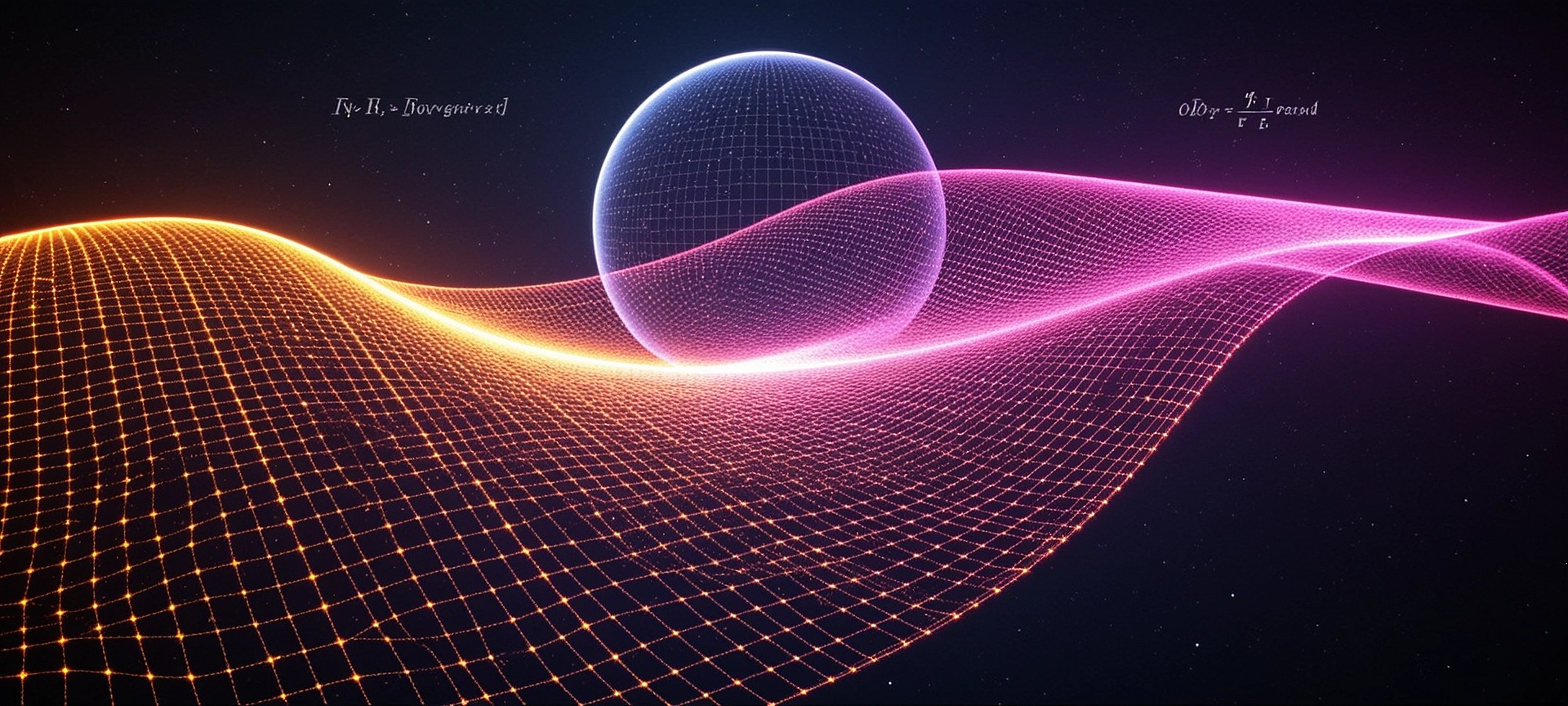
Normal energy curves spacetime inward (gravity attracts). Negative energy curves it outward (gravity repels). The Casimir Effect proves negative energy exists. The Alcubierre warp drive shows what you could do with enough of it.
How It Works
Normal Energy and Gravity
Einstein showed that mass and energy are equivalent (E=mc²) and that both curve spacetime. A star's mass curves spacetime around it, creating the gravitational well that holds planets in orbit. More energy means more curvature. This is the foundation of general relativity.
General relativity includes a set of mathematical constraints called energy conditions: the Weak Energy Condition, Strong Energy Condition, Dominant Energy Condition, and Null Energy Condition. These conditions all assume, roughly, the same thing: energy is positive, and gravity always attracts. Every energy condition says: "the energy density measured by any observer is non-negative." This is what makes the universe behave normally; stars attract planets, galaxies hold together, and spacetime curves inward around mass.
Breaking the Energy Conditions
Quantum mechanics can violate these energy conditions. This is established physics, not speculation. Several quantum phenomena create regions where the vacuum energy density drops below the normal vacuum level, negative energy density:
The Casimir Effect
Two closely spaced metal plates restrict which virtual particles can exist between them. The result: the region between the plates has less energy than the surrounding vacuum, negative energy density. Measured by Lamoreaux in 1997 within 5% of theoretical predictions.
Hawking Radiation
Black holes slowly evaporate because virtual particle pairs near the event horizon get separated: one escapes, the other falls in. The infalling particle must carry negative energy to account for the mass lost by the black hole. Negative energy flowing into a black hole is essential to the theory.
The Unruh Effect
An accelerating observer perceives the quantum vacuum as a thermal bath of particles. This is deeply connected to how different reference frames experience vacuum energy differently, and implies that vacuum energy is observer-dependent and can go negative in certain frames.
Squeezed Light States
In quantum optics, "squeezed" states of light have reduced uncertainty in one observable at the cost of increased uncertainty in another. During certain phases of oscillation, the energy density of squeezed light drops below the vacuum level, negative energy density in a laboratory setting.
The key insight: negative energy is a measured quantum phenomenon, not a hypothetical one. The debate isn't about whether it exists. The debate is about quantity and controllability: can we generate enough of it, in a controlled way, to do anything useful?
Exotic Applications: Warp Drives & Wormholes
In 1994, physicist Miguel Alcubierre published a landmark paper showing that if you could create a bubble of negative energy around a spacecraft, the craft could effectively travel faster than light, while locally remaining stationary in flat spacetime. The Alcubierre warp drive works by contracting space in front of the bubble and expanding space behind it. The spacecraft doesn't move through space; space itself moves around it. No local violation of relativity occurs.
In 1988, Kip Thorne and colleagues (Morris and Thorne) showed that traversable wormholes (stable shortcuts through spacetime) are valid solutions to Einstein's field equations, but they require negative energy to keep the throat open. Without it, the wormhole collapses faster than anything can pass through. The Krasnikov tube is another faster-than-light concept that also requires negative energy to function.
The problem: all of these concepts require enormous amounts of negative energy: far beyond what the Casimir Effect produces at laboratory scales. Alcubierre's original calculations suggested a warp bubble would need more negative energy than the mass-energy of the observable universe. Subsequent refinements (by Harold White at NASA and others) have reduced the requirement dramatically, but it remains well beyond current technology. Negative energy exists; the real question is whether it can be amplified or generated at scale.
Why This Matters for 4Orbs
Forbes' analysis suggests the orbs may use some form of spacetime manipulation for propulsion. They appear to maneuver in ways that suggest they're not pushing against anything: no reaction mass, no visible exhaust, no aerodynamic surfaces. They accelerate, stop, and change direction without any observable propulsive mechanism. If taken at face value, this rules out every conventional form of propulsion.
If the orbs use a localized spacetime distortion (essentially a micro warp bubble), negative energy would be required. This connects to several threads in the investigation:
Salvatore Pais's Navy patents: describe "engineered spacetime modification" using high-energy electromagnetic fields rotating at extreme frequencies. The patent explicitly claims to generate a "local vacuum energy state" different from the surrounding space, language consistent with negative energy generation.
Concentrated electromagnetic energy: if extremely intense EM fields can modify the quantum vacuum state, they might generate localized negative energy density. This would bridge the gap between the tiny Casimir Effect and the larger-scale negative energy needed for spacetime manipulation.
Harold Puthoff's research: Puthoff has published extensively on "engineering the vacuum," proposing that the zero-point field of quantum mechanics could be manipulated to alter local spacetime geometry. His work connects vacuum engineering to both propulsion and energy extraction.
Mainstream vs. Speculative
This site covers both established science and unproven claims. Here's where the line falls for this topic.
Negative energy density exists: the Casimir Effect is experimentally proven and peer-reviewed. General relativity predicts exotic phenomena (warp drives, traversable wormholes) when negative energy is present. The Alcubierre metric is a valid solution to Einstein's field equations. Quantum energy condition violations are established physics; Hawking radiation, squeezed states, and the Casimir Effect all involve negative energy density.
That negative energy can be generated at useful scales beyond the Casimir Effect. That the Salvatore Pais patents describe a real mechanism for engineered spacetime modification. That the MH370 orbs use spacetime manipulation as a propulsion mechanism. That engineering the vacuum is achievable with current or near-future technology. These claims extend well beyond established physics and remain unverified.
Key Terms
Negative Energy
A region of space with less energy than the quantum vacuum, energy density below zero. Not "anti-energy" or the absence of energy, but a measurable state where the local energy density is lower than the baseline vacuum. Proven to exist via the Casimir Effect. In general relativity, negative energy curves spacetime outward instead of inward.
Exotic Matter
Hypothetical matter with negative energy density or negative mass. Unlike antimatter (which has positive mass and positive energy), exotic matter would gravitationally repel normal matter. It is the key theoretical ingredient for warp drives and traversable wormholes. No macroscopic exotic matter has ever been observed or created.
Energy Conditions
Mathematical constraints in general relativity that restrict what kinds of energy-momentum distributions are "physically reasonable." The Weak, Strong, Dominant, and Null Energy Conditions all effectively say "gravity attracts." Quantum mechanics violates these conditions under specific circumstances, opening the door to exotic spacetime geometries.
Alcubierre Warp Drive
A theoretical faster-than-light propulsion concept proposed by Miguel Alcubierre in 1994. By contracting spacetime ahead of a craft and expanding it behind, the craft can effectively exceed the speed of light without locally violating relativity. Requires negative energy to create the warp bubble. A valid solution to Einstein's field equations.
Casimir Effect (Negative Energy)
The experimentally verified phenomenon where two closely spaced plates experience an attractive force due to restricted quantum vacuum fluctuations between them. The region between the plates has negative energy density relative to the surrounding vacuum. First predicted by Hendrik Casimir in 1948, confirmed by Lamoreaux in 1997.
Traversable Wormhole
A stable "shortcut" through spacetime connecting two distant points. Unlike Schwarzschild wormholes (which collapse instantly), traversable wormholes remain open long enough for matter or information to pass through. Requires negative energy to hold the throat open. First analyzed by Morris and Thorne in 1988 as valid solutions to Einstein's equations.
Vacuum Engineering
The theoretical concept of manipulating the quantum vacuum state of space to alter its energy density, modify local spacetime geometry, or extract usable energy. Proposed by Harold Puthoff and others as a potential pathway to advanced propulsion and energy generation. Remains highly speculative but grounded in real quantum field theory.