Spacetime Curvature for Beginners
General relativity without the math
In Plain English
For most of human history, we thought of space as a fixed, invisible stage, an empty container where things happen. Time was a separate clock ticking away at the same rate for everyone, everywhere. Newton built his entire system of physics on these assumptions, and it worked beautifully for over two centuries. But in 1915, Albert Einstein showed that both assumptions were wrong. Space and time are a flexible, dynamic fabric that bends and stretches in response to mass and energy, not a fixed background.
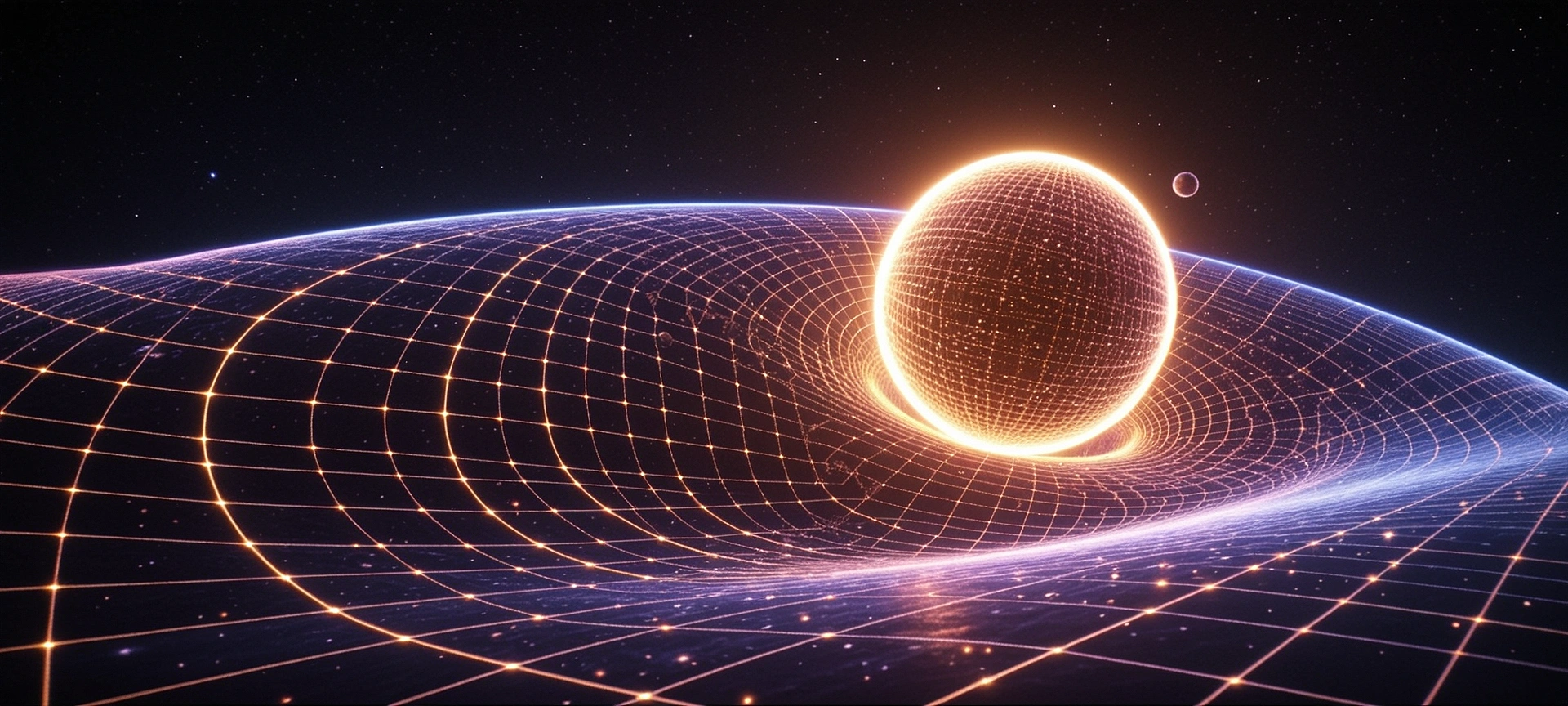
The easiest way to picture this is the classic "rubber sheet" analogy. Imagine stretching a flat rubber sheet tightly across a frame. Now place a heavy bowling ball in the center. The sheet dips downward around the ball, creating a curved depression. If you roll a marble across the sheet, it won't travel in a straight line anymore; it will curve toward the bowling ball, spiral around it, maybe even fall in. That marble isn't being "pulled" by some invisible force. It's simply following the curved surface of the sheet. This is exactly what gravity is in Einstein's picture: curved geometry, not a force.
Einstein's revolutionary insight was this: objects in free fall don't feel any force at all. An astronaut orbiting Earth is weightless because the astronaut is following the natural curvature of spacetime, not because gravity has disappeared. The Moon orbiting Earth, Earth orbiting the Sun, galaxies drifting through the cosmos: none of them are being "pulled." They are all traveling along the straightest possible paths through curved spacetime. These paths are called geodesics, and understanding them is the key to understanding general relativity.
This isn't just abstract philosophy. General relativity is one of the most precisely tested theories in all of science. GPS satellites have to correct for spacetime curvature: without Einstein's equations, your phone's location would drift by about 10 kilometers per day. Gravitational waves, ripples in the fabric of spacetime itself, were directly detected in 2015, exactly as Einstein predicted a century earlier. The bending of starlight around the Sun was confirmed during a solar eclipse in 1919, making Einstein a household name overnight.
How Mass Curves Spacetime
Flat space has a simple grid. Add mass, and the grid warps. Objects don't get "pulled"; they follow the curved paths (geodesics) that the warped grid creates.
How It Works
The Rubber Sheet (But Better)
The rubber sheet analogy is a useful starting point, but it has real limitations. First, it only shows two dimensions of space curved into a third; real spacetime has four dimensions (three of space plus one of time) all curving together. Second, the rubber sheet analogy seems to need "gravity pulling the bowling ball down" in order to work, which is circular reasoning if you're trying to explain gravity itself. The analogy works as a visualization tool, not a literal description.
A better way to think about it: spacetime curvature means that the rules of geometry change near massive objects. In flat space, the angles of a triangle add up to 180°. Near a massive star, they add up to more than 180°. Parallel lines that start out perfectly straight will converge toward each other near a mass. Distances and durations measured by different observers won't agree. The fabric of reality itself is warped.
Einstein described this mathematically using a tool called the metric tensor, essentially a set of equations that tells you how to measure distances and time intervals at every point in spacetime. Near a massive object, those measurements change. Far from any mass, spacetime is approximately flat and Newton's simpler equations work fine. But near stars, black holes, or at high speeds, you need Einstein's full geometric description.
Geodesics: The Straightest Possible Path
On a flat surface, the shortest distance between two points is a straight line. On a curved surface, like the surface of the Earth, the shortest path between two points is a curve called a geodesic. When you fly from New York to London, the plane follows a great circle route that arcs up toward Greenland. On a flat map this looks curved, but on the actual globe it's the straightest, shortest path. The same principle applies in curved spacetime.
The Earth orbiting the Sun isn't being "pulled" by an invisible rope. Instead, the Sun's enormous mass curves spacetime around it, and the Earth follows a geodesic, the straightest possible path through that curved geometry. To the Earth, it feels like it's traveling in a straight line. It's spacetime itself that's curved, making that "straight line" loop back around into an orbit. This is why astronauts in orbit are weightless: they're in free fall, following a geodesic, and experiencing no force at all.
Different starting conditions produce different geodesics. A slow-moving object near a star will spiral inward. A fast-moving object at the right speed and distance will orbit in a circle or ellipse. An even faster object will follow a curved flyby path, deflected by the curvature but not captured. And light itself follows geodesics too, which is why massive galaxies can act as "gravitational lenses," bending and magnifying the light from objects behind them.
Time Curves Too
Spacetime curvature doesn't just affect the "space" part; it affects time as well. Near a massive object, time runs slower. Clocks physically tick at different rates depending on where they are in a gravitational field; this isn't a metaphor or an illusion. A clock on the surface of the Earth runs slightly slower than an identical clock on a mountaintop. A clock near a black hole would nearly stop relative to a clock far away.
This effect (called gravitational time dilation) has been measured with incredible precision. In 2010, physicists at NIST used ultra-precise aluminum ion clocks to measure the time difference between two heights separated by just 33 centimeters (about one foot). The lower clock ran slower, exactly as Einstein predicted. The effect is tiny at Earth's surface, roughly one part in 10 billion, but it adds up.
The most familiar real-world consequence is GPS. Each GPS satellite carries atomic clocks that tick faster than identical clocks on the ground by about 38 microseconds per day: partly because they're farther from Earth's mass (general relativity makes their clocks faster) and partly because they're moving fast (special relativity makes their clocks slower). Without correcting for both effects, GPS positions would drift by roughly 10 kilometers per day. Every time you use a map on your phone, you're relying on Einstein's theory of spacetime curvature.
Why This Matters for 4Orbs
Ashton Forbes' thesis involves the Alcubierre warp drive, a theoretical propulsion concept first proposed by physicist Miguel Alcubierre in 1994. The Alcubierre metric describes a "bubble" of warped spacetime: space contracts in front of the craft and expands behind it, carrying the craft forward without it actually moving through local space. The craft sits in a flat region at the center of the bubble while spacetime itself does the work.
To even begin evaluating whether such a concept is physically plausible, you need to understand how spacetime curvature works in the first place. The Alcubierre drive is derived directly from Einstein's field equations, so it doesn't break general relativity. The question isn't whether the math works (it does), but whether the energy requirements can ever be met. The original formulation required negative energy densities equivalent to the mass of Jupiter. Later refinements by physicists like Harold "Sonny" White at NASA's Eagleworks laboratory reduced the theoretical requirements substantially, but the concept remains unproven.
Forbes also references the Pais Effect, a set of patents filed by Salvatore Pais through the US Navy, claiming that rapidly rotating electromagnetic fields could generate spacetime curvature effects. Understanding what spacetime curvature actually is, a geometric distortion of space and time caused by mass-energy, is prerequisite to understanding why these claims are extraordinary, what they would require, and why mainstream physicists remain skeptical.
Mainstream vs. Speculative
This site covers both established science and unproven claims. Here's where the line falls for this topic.
General relativity is one of the most rigorously tested theories in physics. Spacetime curvature, gravitational time dilation, gravitational lensing, gravitational waves, all confirmed to extraordinary precision. GPS satellites rely on these corrections every second of every day. None of the science on this page is controversial.
That spacetime curvature can be engineered at will using exotic matter or high-energy electromagnetic fields. The Alcubierre warp drive is mathematically valid but requires energy conditions that may be impossible to achieve. The Pais Effect patents claim to generate spacetime distortion via rotating EM fields; this remains unverified and outside mainstream physics consensus.
Key Terms
Spacetime
The four-dimensional fabric combining three dimensions of space and one of time into a single unified structure. In general relativity, spacetime is a dynamic entity that bends, stretches, and ripples in response to mass and energy, not just a backdrop.
Curvature
The bending or warping of spacetime caused by the presence of mass or energy. Near a massive object, spacetime geometry deviates from flat (Euclidean) geometry: parallel lines converge, triangles have angle sums greater than 180°, and clocks tick at different rates.
Geodesic
The straightest and shortest possible path between two points in curved spacetime. In flat space, a geodesic is a straight line. In curved spacetime near a star, geodesics are the orbits, flyby trajectories, and free-fall paths that objects naturally follow without any force acting on them.
Gravitational Time Dilation
The phenomenon where time passes more slowly in stronger gravitational fields (closer to massive objects). A clock at sea level ticks slightly slower than a clock on a mountain. This is a real, measurable difference confirmed by atomic clocks and essential for GPS accuracy, not an illusion.
Mass-Energy Equivalence
Einstein's E=mc² reveals that mass and energy are interchangeable. In general relativity, both mass and energy curve spacetime. This means light, heat, pressure, and electromagnetic fields all contribute to the curvature of spacetime, not just "heavy objects."
Frame Dragging
A rotating massive object doesn't just curve spacetime; it drags spacetime around with it, like a spinning ball in honey. This effect, also called the Lense-Thirring effect, was confirmed by NASA's Gravity Probe B experiment in 2011 and is relevant to theories about engineered spacetime distortion.