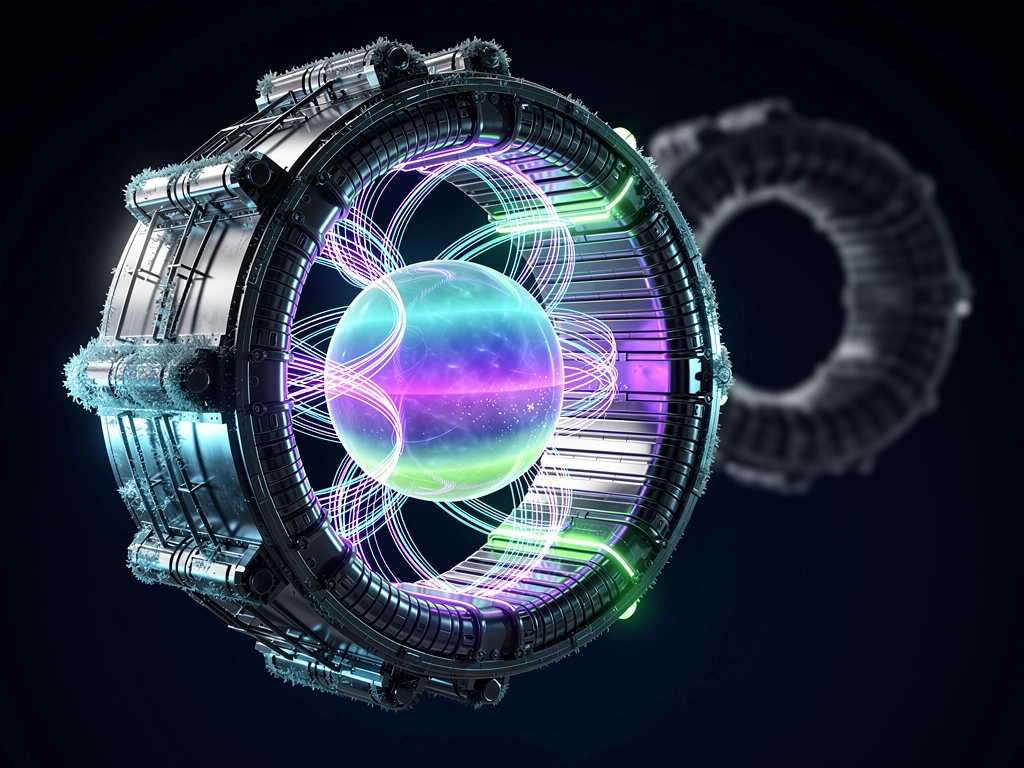
High-Beta Fusion
One number tells you whether a fusion machine can produce useful power. It's called beta, and almost every public fusion program is on the wrong side of it.
In Plain English
Fusion uses magnetic fields to hold a plasma at temperatures hot enough for atomic nuclei to merge. The plasma wants to expand. The magnetic field pushes back. The two forces balance, and the plasma sits in a confined region long enough for fusion to happen.
The ratio of how much pressure the plasma is producing to how much pressure the magnetic field is producing is called beta. Just one Greek letter, β. Higher beta means more fusion power for the same magnet. A beta of 1 means the plasma is exerting as much pressure as the magnetic field, which is the maximum stable value before the field can no longer hold the plasma in place.
Almost every public fusion machine in the world operates at beta around 0.1. ITER is targeting 0.025. JET ran at 0.04. The reason isn't that physicists don't know how to push beta higher. It's that the geometry they chose (the tokamak) is unstable above about 0.1, so the engineering optimises around that ceiling.
But the fusion power output scales as beta squared times magnetic field to the fourth power. Doubling beta gives you four times the power. Going from beta 0.1 to beta 1 (a factor of 10) gives you 100 times the power. And separately, doubling the magnetic field strength gives you sixteen times the power on top of that.
That's the punchline. A high-beta machine with a strong magnet doesn't produce twice as much fusion as a low-beta machine. It produces a thousand times more. The question is: why isn't every fusion program built that way?
The Beta Equation
Plasma beta is defined as the ratio of plasma pressure to magnetic pressure:
Plasma pressure (the numerator) is what makes the fusion happen. Magnetic pressure (the denominator) is what holds it in place. The ratio tells you how much of your magnet's energy density is being used to produce fusion versus just keeping the plasma from leaking out.
Now the fusion power per unit volume scales as plasma pressure squared (more density and higher temperature, both squared, give more reactions per second). And plasma pressure equals beta times magnetic pressure, which scales as B squared. So total fusion power per unit volume scales as β² × B&sup4;.
Read that exponent carefully. The fourth power on the magnetic field is why the entire fusion field has been chasing high-field magnets for sixty years. Doubling the field gives you 16x the power. Quadrupling the field gives you 256x the power. Halving the field gives you 1/16 the power, which is why the early low-field tokamaks produced almost nothing.
And the squared dependence on beta is why high-beta geometries matter. Going from β = 0.1 to β = 1 isn't a factor of 10 in power, it's a factor of 100. That's the difference between a research curiosity and a working power plant.
Why Tokamaks Are Stuck at Beta 0.1
A tokamak is a magnetic donut, technically a torus, with a strong external toroidal field running the long way around the ring and a weaker poloidal field running the short way around. The combination produces helical field lines that wrap the plasma into a stable shape.
The problem is the Troyon limit. Named after Francis Troyon, who derived it in 1984, this is a stability ceiling that says a tokamak's beta can't exceed about 0.04 times the safety factor q (a measure of how tightly the field lines wind), or you get magnetohydrodynamic instabilities that destroy the plasma in milliseconds. For typical tokamak parameters, that puts the practical beta ceiling at 0.1, sometimes pushed to 0.15 with active control.
Above the limit, the plasma develops kink modes, ballooning modes, or a sudden disruption that dumps the entire plasma current into the vessel walls in a few milliseconds. ITER's vessel is built to survive several disruptions per day. A commercial tokamak couldn't be.
So the tokamak community optimises around the limit. ITER's design beta is about 0.025, well below the Troyon ceiling, with the rest of the performance budget going into raw size: a plasma volume of 840 cubic metres, the largest fusion plasma ever attempted. Size compensates for low beta. ITER will work, but it has to be enormous, and enormous costs $25 billion and takes 30 years.
That's the trade-off the entire tokamak path has been making since the 1970s. Low beta, low risk, big machine, slow progress.
The High-Beta Geometries
A handful of fusion geometries naturally support beta close to 1. They've existed in the literature for decades. None has received tokamak-scale funding.
Field-reversed configuration (FRC). Beta typically 0.7 to 1. The plasma's own current generates the confining field, so there's no separate external coil to underuse. TAE Technologies (formerly Tri Alpha Energy) runs steady-state beam-driven FRCs aimed at p-B11; Helion Energy runs a pulsed magneto-inertial FRC variant aimed at D-He3. See our FRC 101 guide for the geometry details.
Spheromak. Beta around 0.2 to 0.5. A self-organised compact toroid that holds itself together through internal currents and minimal external coils. Lawrence Livermore ran the SSPX program in the 2000s; General Fusion still pursues a magnetised target variant.
Z-pinch and dense plasma focus. Beta 1 by construction (the plasma pressure equals the pinch pressure at peak compression). Pulsed devices, very compact, but historically limited by hydrodynamic instabilities. Recent work at ZAP Energy (Seattle) has demonstrated stable operation by adding sheared axial flow.
Magnetised target fusion. Beta 1 at peak compression. A pre-magnetised plasma is rapidly compressed by an imploding metal liner. Los Alamos, General Fusion, and HB11 all use variants. Yields can be tuned from sub-kiloton (weapons-relevant) to civilian power generation.
All four geometries have been investigated since the 1970s. All four hit their stride only when private capital arrived in the 2010s, because the institutional fusion funding had been locked up in tokamak research.
The 20-Tesla Moment
On September 5, 2021, Commonwealth Fusion Systems and the MIT Plasma Science and Fusion Center demonstrated a 20-tesla magnetic field from a high-temperature superconducting REBCO magnet. The magnet was the size of a small car. It used rare-earth barium copper oxide tape (REBCO, technically YBCO) wound into a fusion-relevant geometry, cooled to about 20 kelvin (warm enough that liquid helium isn't needed, just a closed-cycle cryocooler).
Twenty tesla is the field strength tokamak designers have wanted for fifty years. ITER uses 11.8-tesla magnets that are the size of a 747 and need liquid helium plumbing. CFS's 20-tesla magnet does double the field at a fraction of the size and complexity. And remember the β² × B&sup4; scaling: doubling B from 10 to 20 gives you 16 times the fusion power per unit volume, before you even touch beta.
CFS's commercial design, SPARC, will use these magnets in a tokamak geometry to produce net energy gain in a much smaller machine than ITER. ARC, the follow-on, is targeted as a power plant. Both stay at tokamak-class beta 0.1, but the high field carries the rest of the load.
What's not public is whether 20-tesla REBCO magnets have been combined with high-beta geometries. An FRC at beta 1 with 20-tesla compression fields would deliver fusion conditions in a device the size of a fridge, not a building. The physics says it should work. The engineering exists in the open literature for both halves of the system. Whoever combines them first changes the entire fusion economics conversation.
Forbes argues that whoever combined them first has been doing it inside a Special Access Program for at least a decade, and that the MH370 orbs are the demonstration that the physics is fielded. We can't verify that. What we can verify is that all the pieces are sitting in plain sight.
Where to Read Next
Beta and field strength are the two parameters that determine whether a fusion machine is economically useful. The institutional choice has been to push field strength while keeping beta low. The alternative-concept community went the other way: high beta, smaller machines, and now (with REBCO) high field on top. The combination is what compact fusion has been waiting for.
The Miley 2016 research page walks through one specific paper that combines all the high-beta ingredients: picosecond laser ignition, kilotesla pulsed magnetic confinement, and aneutronic p-B11 fuel. The FRC 101 guide covers the most successful continuous-mode high-beta geometry. The Gsponer paper trail connects the same physics to the weapons side of the conversation, where the β² × B&sup4; scaling matters even more than it does for civilian power.
One number. Squared. Times another number. To the fourth power. That's the entire economic case for compact fusion, and the entire physics case for the 4Orbs technology cluster.