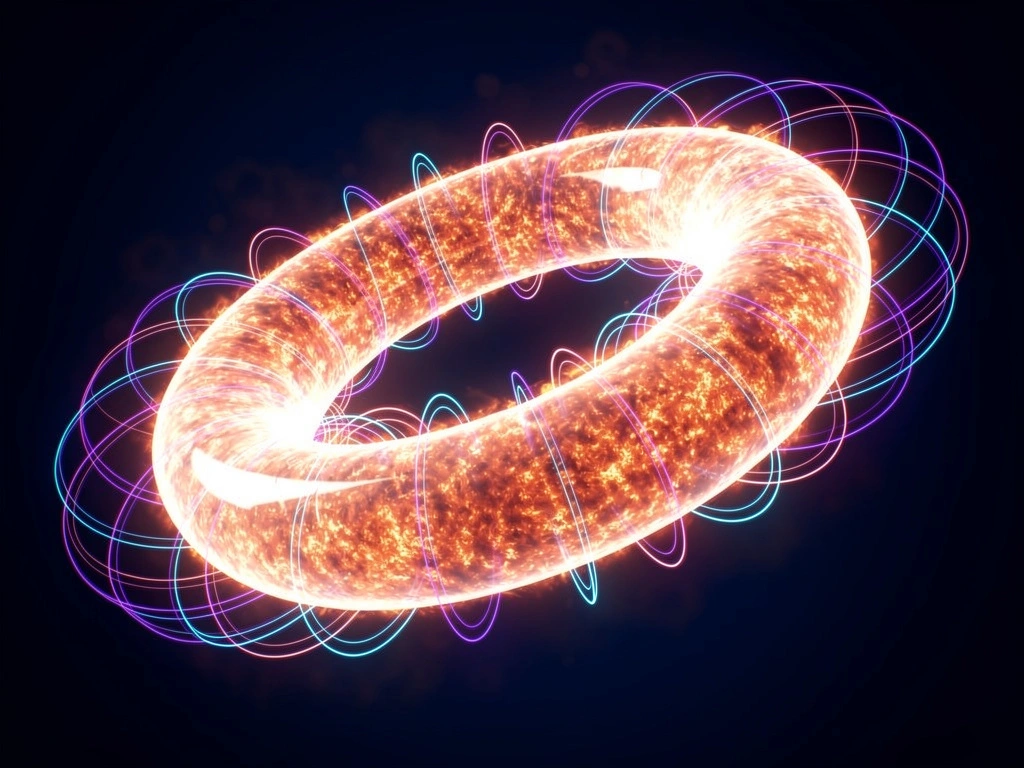
Field-Reversed Configuration
The compact plasma geometry that runs on its own magnetic field.
In Plain English
Imagine a smoke ring. A donut-shaped blob of smoke spinning around its own axis, holding its shape as it drifts across the room. The shape holds because the smoke is circulating. The circulation creates the structure.
A field-reversed configuration, FRC for short, is the plasma version of that smoke ring. A compact, donut-shaped blob of ionised gas that holds itself together through its own magnetic field. The plasma circulates, the circulation generates a field, and the field pushes back against the circulation in a self-sustaining equilibrium. Unlike a tokamak (the giant donut reactor ITER is trying to build in France) an FRC doesn't need massive external coils to keep the plasma contained. The plasma does most of the work itself.
That makes an FRC small. A tokamak for serious fusion research fills a building. An FRC can fit in a shipping container. The physics is the same fusion physics; the geometry is just more compact.
Why does that matter for 4Orbs? Because Ashton Forbes' specific claim about the MH370 orbs is that they are field-reversed configuration plasmoids using aneutronic fuel, built on the same physics that Tri Alpha Energy, Helion, and now TAE Technologies have been pursuing as commercial fusion since 1998. The orb shape, the glow, the compact size, the absence of a fission signature: all of that maps onto what an FRC would look like if it were built as a weapon.
How the Geometry Works
A tokamak has two magnetic fields. A toroidal field (around the ring, supplied by external coils) and a poloidal field (the short way around the plasma, supplied by current flowing in the plasma itself). You need both. The combination gives you a stable plasma confinement surface, but it needs external coils big enough and powerful enough to dominate the plasma's own field. That's why tokamaks get enormous.
An FRC only has one field. The poloidal one, produced by current circulating in the plasma. No external toroidal coil. The plasma current creates a closed magnetic surface that the plasma itself sits inside. The "field reversal" in the name means that inside the plasma, the magnetic field points in the opposite direction to the field outside the plasma. A separatrix, the boundary surface where the field reverses, defines the edge.
Here's the useful part: because the external field is just the return flux of the internal current, the ratio of plasma pressure to magnetic pressure (called beta) can approach 1. In a tokamak, beta is limited to about 0.1 by stability constraints. You're using 90% of your magnetic field to hold the plasma and only 10% of the field's energy density to produce fusion. An FRC uses almost all of it. For a given magnet, you get ten times more fusion output.
That sounds like a miracle. It isn't quite. FRCs have their own stability problems (tilt modes, rotational instabilities, kink modes) that took decades to solve. But the solutions exist, and the first commercial FRC reactors are now entering operation.
Who Built the First Ones
The FRC was discovered almost by accident in the 1950s, during plasma experiments at the Naval Research Laboratory. Theta-pinch machines, intended to produce linear plasma columns, occasionally produced closed-field-line plasmoids inside the pinch. It took a decade for researchers to realise these were a new kind of plasma equilibrium rather than an experimental oddity.
Through the 1970s and 80s, FRC research happened at Los Alamos (the FRX series), the University of Washington (TCS and the Rotamak program), and Spectra Technology. The Department of Energy funded the work at a modest level as an "alternative concept" inside the broader magnetic fusion budget. By the 1990s, as tokamak research consolidated around ITER, FRC budgets were cut back. A lot of the institutional knowledge ended up at private companies.
Tri Alpha Energy, founded in 1998 by Norman Rostoker and colleagues from UC Irvine, took FRC physics in a specific direction. Instead of pulsed FRCs held together for microseconds, they built a continuous-beam-driven FRC with co-rotating ion beams that sustained the plasma current indefinitely. The company changed its name to TAE Technologies in 2017. As of August 2026 it states it has raised more than $1.5 billion from investors including Google, Venrock, and Vulcan Capital. Their current reactor, Norman, has demonstrated stable plasma for long durations at the required temperatures.
Helion Energy, founded in Everett, Washington, uses a different FRC approach: colliding pairs of FRC plasmoids and compressing them with pulsed magnetic fields. The resulting fusion reactions produce energy directly as electricity through induction, skipping the thermal cycle. Helion has a $500M commitment from OpenAI's Sam Altman and Microsoft as its first utility-scale customer. Their Polaris machine is under construction.
Both companies are pursuing proton-boron-11 fusion. Both rely on the high-beta property that only an FRC can deliver.
Why This Shape for MH370?
Forbes' argument for identifying the MH370 orbs as FRC plasmoids rests on four observable features.
Compactness. The objects in the videos are metres across, not kilometres. A tokamak-scale device is out. A laser-driven ICF pellet is too small and the laser apparatus is too big. An FRC is the only geometry that produces a fusion-capable plasma at the metres-across scale without requiring a building-sized support structure around it.
Self-luminous glow. The orbs emit light. Plasma at fusion-relevant temperatures radiates strongly in the visible through bremsstrahlung and line emission. An FRC plasma looks like a glowing sphere or oblate spheroid from outside, with brightness dropping off at the separatrix. The observed orb geometry matches.
Maneuverability. An FRC in free flight, not inside a confinement machine, can be pushed around by external magnetic fields because the plasma current interacts with any ambient field gradient. The orb movements in the videos (non-ballistic, apparently tracking the aircraft) are consistent with an externally-steered FRC rather than a rigid body obeying gravity.
No detonation signature. An FRC burning p-B11 fuel produces almost no neutrons and no fission products. The Vela and SBIRS satellite networks that watch for nuclear detonations are calibrated against fission signatures. An aneutronic FRC burst would not trigger them. The reported absence of any "explosion" in the US satellite data on March 8, 2014, is consistent with an FRC event.
None of this proves the orbs are FRC plasmoids. It establishes that the FRC geometry is the only public physics model that explains all four features simultaneously. When someone builds a better model, we'll link to it. Until then, the FRC hypothesis is the specific, testable, physics-grounded version of the orb claim.
Where to Read Next
FRC physics connects to almost every other thread in the 4Orbs investigation. If you came here from the orb videos, read MH370: The Orbs for the specific visual evidence and Fourth-Generation Nuclear Weapons for why a device using this physics wouldn't show up on the Vela or SBIRS detectors.
If you came here from the fusion thread, the Miley 2016 research page walks through the specific reactor paper that uses picosecond lasers to ignite the plasma and kilotesla fields to confine it. The High-Beta Fusion 101 article explains the plasma-beta parameter that makes the FRC geometry possible in the first place.
And if you came here for the physics, the geometry alone is worth your time. It's the most elegant solution to plasma confinement anyone has found, and the fact that it took sixty years to commercialise says more about research funding priorities than about the underlying science.