Quantum Mechanics
The Rules Beneath Reality
In Plain English
In 1900, Max Planck broke physics. He was trying to explain why hot objects glow the colours they do, a problem that classical physics couldn't solve without producing absurd infinities. His fix was radical: energy isn't continuous. It comes in discrete packets. Quanta. That single insight detonated a chain reaction that, over the next three decades, rewrote every rule governing the behaviour of matter at the atomic scale.
Niels Bohr, Werner Heisenberg, Erwin Schrödinger, Paul Dirac, Max Born: between roughly 1913 and 1930, these physicists built a framework that explained why atoms don't collapse, why light sometimes behaves like a wave and sometimes like a bullet, and why the act of measuring a particle changes what you find. What they built was deeply strange. It contradicted common sense at every turn. And it worked, with a precision that no other theory in the history of science has matched.
Quantum electrodynamics, the quantum theory of light and matter, agrees with experiment to 12 decimal places. That's like predicting the distance from London to New York accurate to the width of a human hair. No theory in any field of science comes close to that level of confirmation.
Here's why this matters for everything else on this site. Zero-point energy, the Casimir effect, plasma confinement, entanglement, consciousness research: every one of those topics rests on quantum mechanics. You can't evaluate Forbes' claims about vacuum energy extraction or ER=EPR wormholes or tunneling-enhanced fusion without understanding what's on this page first.
The Double Slit, Run Twice
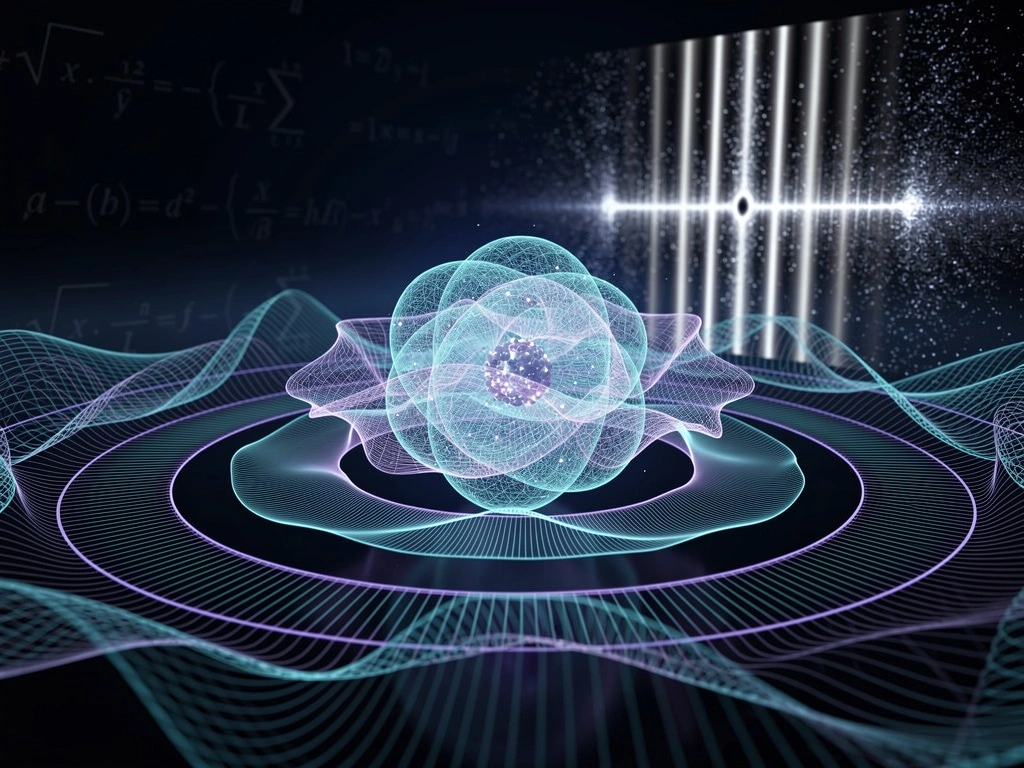
Nearly everything on this page comes out of one experiment. Fire particles at two slits one at a time and they build a pattern only a wave could make, which means each particle went through both. Switch on a detector that records which slit, change nothing else, and the pattern disappears. Same apparatus, same particles, one difference: whether anyone looked.
How It Works
Wave-particle duality
Thomas Young settled this question in 1801. He shone light through two narrow slits and got an interference pattern on the wall behind them: bright and dark bands where waves overlapped and cancelled. Light is a wave. Case closed. Published in the Philosophical Transactions of the Royal Society, universally accepted, argument over.
Then Einstein reopened it. In his 1905 paper in Annalen der Physik, he showed that light also comes in discrete packets: photons. Individual particles carrying specific amounts of energy. The photoelectric effect proved it. Shine light on a metal surface: below a certain frequency, no electrons get knocked loose regardless of how bright the beam is. Only higher-frequency photons carry enough energy per particle to eject an electron. Waves don't behave like that. Particles do.
So which is it?
Both. Fire individual electrons through a double slit, one at a time. Each electron hits the detector at a single point. Particle. But fire thousands of them, and the accumulated hits form an interference pattern. Wave. Each electron went through both slits simultaneously and interfered with itself. Now put a detector at the slits to watch which path the electron takes. The interference pattern vanishes. Just like that: one slit, a well-behaved particle, no wave behaviour at all. Observation changes the outcome. This isn't a thought experiment. It's been confirmed in laboratories around the world since the 1960s, with electrons, neutrons, and even molecules containing over 800 atoms.
Superposition
Before you measure a quantum particle, it doesn't have a definite state. An electron's spin isn't "up" or "down" until you check. It exists in a superposition: a mathematical combination of all possible states, weighted by probability amplitudes encoded in Schrödinger's wave function. This isn't a statement about our ignorance. The electron isn't secretly spin-up while we happen not to know. The state genuinely isn't determined.
That's a strong claim, and for decades physicists argued about whether it was really true or just a useful mathematical trick. John Bell settled the argument in 1964 with a theorem published in Physics, Volume 1, Issue 3. Bell proved that if particles had definite hidden states all along (as Einstein insisted), then measurements on entangled pairs would obey a specific statistical inequality. In 1982, Alain Aspect and his team at the Institut d'Optique in Orsay ran the experiment. The inequality was violated. The universe sided with quantum mechanics. Hidden variables of the type Einstein imagined don't exist.
Schrödinger tried to show how absurd this was. His 1935 thought experiment: put a cat in a sealed box with a radioactive atom, a Geiger counter, and a vial of poison. If the atom decays (a quantum event), the counter triggers, the poison releases, the cat dies. Before you open the box, the atom is in a superposition of decayed and not-decayed. So is the cat alive and dead simultaneously? Schrödinger meant it as a reductio ad absurdum. Quantum mechanics said yes. Eighty years of experiments have found no upper size limit where superposition breaks down. The question of why we don't see cats in superposition is called the measurement problem, and nobody has solved it.
The uncertainty principle
Heisenberg, 1927. Published in Zeitschrift für Physik, Volume 43. You can't simultaneously know a particle's exact position and exact momentum. Not because your instruments aren't good enough. Because the universe doesn't allow it. The product of the two uncertainties can never drop below a fixed constant. Pin down position and momentum blurs. Constrain momentum and position spreads.
This isn't a curiosity. It's the reason empty space has energy. Confining a system to exactly zero energy at a definite time violates the energy-time version of the uncertainty relation. So even a perfect vacuum, cooled to absolute zero, stripped of every particle, still seethes with residual energy fluctuations. That's zero-point energy. The Casimir effect (covered in its own 101 guide) is a direct laboratory measurement of those fluctuations. The uncertainty principle doesn't just describe nature. It produces the vacuum energy that underpins half the physics on this site.
Quantum tunneling
Roll a ball at a hill. If it doesn't have enough energy to reach the top, it rolls back. Every time. Classical physics is absolute about this. But George Gamow showed in 1928 that quantum particles don't obey that rule. A particle encountering an energy barrier it classically can't cross has a non-zero probability of appearing on the other side. It tunnels through. The probability drops exponentially with barrier width, but it never hits zero.
The sun runs on tunneling. Protons in the solar core have a temperature of about 15 million degrees Celsius. That sounds extreme, but it's actually far too cold for protons to overcome their mutual electrostatic repulsion at the rates required to power a star. Classical physics says the sun shouldn't work. Quantum tunneling lets protons fuse anyway, punching through the Coulomb barrier at a rate that matches observed solar luminosity almost exactly. Without tunneling, no stars. No sunlight. No us.
This isn't exotic technology. Flash memory stores data by trapping electrons behind an oxide barrier using quantum tunneling. Scanning tunneling microscopes image individual atoms by measuring the tunneling current between a sharp tip and a surface. Every time you save a file, tunneling is involved. Forbes argues that classified programs have found ways to enhance tunneling rates beyond what nature provides on its own, achieving aneutronic fusion in compact devices decades ahead of public knowledge. That claim sits at the speculative end of the confidence spectrum, but the underlying physics is as solid as it gets.
The measurement problem
Measure a quantum system and the superposition collapses into one definite result. The wave function, which encoded all possible states, snaps to a single outcome. But what counts as a "measurement"? Does it require a conscious observer? A macroscopic apparatus? Any physical interaction at all? Nobody agrees. And this isn't a fringe debate: it's the central unsolved problem in the foundations of physics.
The Copenhagen interpretation, developed by Bohr and Heisenberg in the 1920s, says: don't ask. The wave function is a tool for calculating probabilities, not a description of reality. It works. Shut up and calculate. The Many-Worlds interpretation, proposed by Hugh Everett in 1957, says every measurement splits the universe into branches where each possible outcome occurs. John Cramer's Transactional Interpretation (1986, University of Washington) uses waves travelling backward and forward in time. David Bohm's pilot-wave theory says particles have definite positions all along, guided by a real wave that we can't directly observe.
All of these interpretations produce identical experimental predictions. The math is the same. The philosophy is completely different. And that philosophical difference matters far more than mainstream physics acknowledges, because if consciousness plays a role in wave function collapse, then physics and consciousness aren't separate domains. They're the same domain. That question connects directly to the consciousness and reality research covered elsewhere on this site: the holographic universe, implicate order, and the zero-point field as an information substrate.
Why This Matters for 4Orbs
Every advanced physics topic on this site traces back to something on this page. The uncertainty principle forces the quantum vacuum to contain energy. That energy produces the Casimir effect, which is a measured laboratory fact. Zero-point energy extraction, the technology Forbes argues has been suppressed for decades, depends on whether that vacuum energy can be tapped at useful scales. You can't evaluate that claim without understanding where the energy comes from. It comes from Heisenberg's result. Period.
Tunneling is the mechanism that makes fusion possible at temperatures orders of magnitude below what classical physics demands. Forbes argues that classified Navy programs have exploited enhanced tunneling to achieve aneutronic p-B11 fusion in compact field-reversed configuration devices. The physics of tunneling is established fact. Whether it can be enhanced beyond naturally occurring rates is an open question. But the baseline mechanism, the thing that powers every star in the observable universe, is on this page.
Now consider the measurement problem. If observation collapses quantum states, and if the definition of "observation" involves consciousness, then consciousness is a fundamental feature of physics rather than a byproduct of neural computation. The CIA's Project Stargate spent decades and millions of dollars investigating exactly that possibility. The Princeton PEAR laboratory collected 28 years of data on consciousness-machine interaction. Whether those programs found anything real is debated. That they were funded at all tells you that people inside the intelligence community took the quantum-consciousness connection seriously enough to classify the results.
Mainstream vs. Speculative
Wave-particle duality, superposition, the uncertainty principle, tunneling, and the measurement problem are all experimentally confirmed. Bell's inequality has been violated in dozens of independent experiments since Aspect's 1982 result. QED is the most precisely tested theory in science. None of this is contested by any working physicist.
Which interpretation of quantum mechanics is correct remains open. Whether consciousness plays a causal role in measurement, whether macroscopic quantum effects can be engineered, and whether tunneling rates can be enhanced beyond natural limits are active research questions, not settled science. Forbes' claims about classified programs exploiting these possibilities sit at the working-hypothesis level.
Key Terms
Superposition
A quantum system existing in multiple states simultaneously until measured. Not ignorance about a hidden state: the state genuinely isn't determined. Confirmed by violation of Bell's inequality (Aspect, 1982).
Wave function (ψ)
Schrödinger's mathematical object encoding the probability of finding a particle in any given state. The square of its amplitude gives the probability of each outcome. Governs all quantum predictions.
Uncertainty principle
Heisenberg's 1927 result: certain pairs of properties (position/momentum, energy/time) can't both be exactly determined. A fundamental limit built into reality, not an instrument problem. Directly produces zero-point energy.
Quantum tunneling
A particle crossing an energy barrier it classically can't surmount. Probability drops exponentially with barrier width but never reaches zero. Powers solar fusion (Gamow, 1928) and flash memory.
Wave-particle duality
Quantum objects exhibit wave behaviour (interference, diffraction) and particle behaviour (discrete detection events) depending on how they're measured. Demonstrated in Young's double-slit experiment (1801, light) and electron double-slit experiments (1960s onward).
Measurement problem
Why and how does a quantum superposition collapse into one definite result when measured? Copenhagen, Many-Worlds, Transactional (Cramer, 1986), and pilot-wave (Bohm) interpretations all give the same math but disagree on the answer. Unsolved.