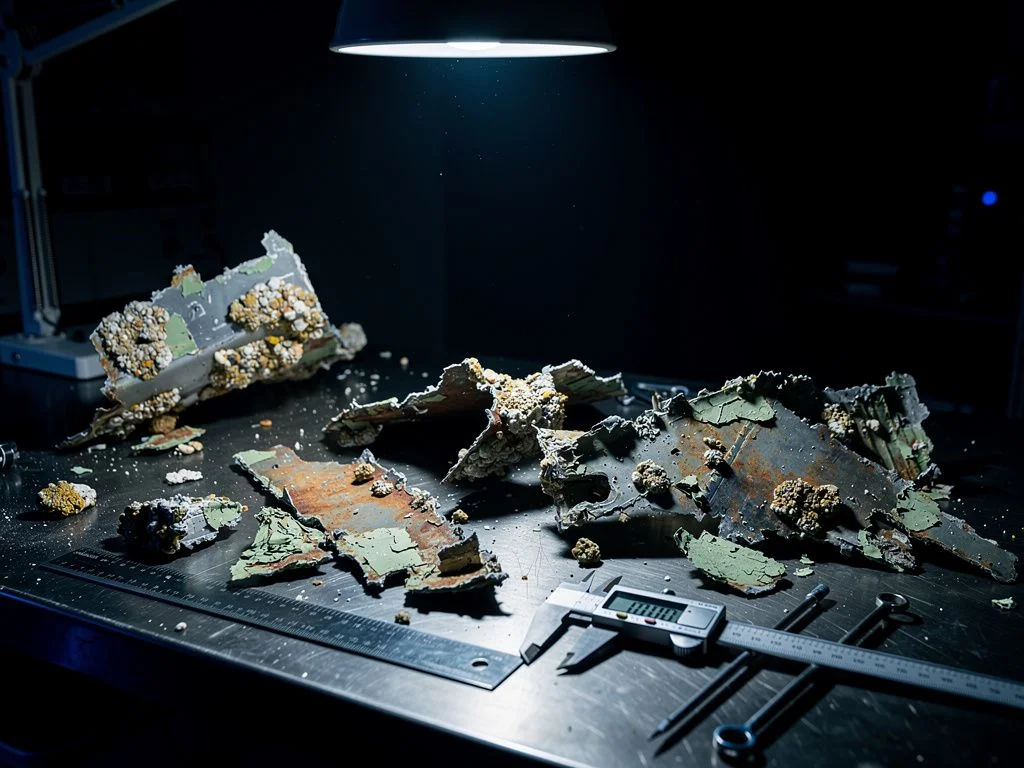
Debris Analysis
33 confirmed or likely pieces of MH370 wreckage have been recovered from Indian Ocean coastlines. This analysis examines the debris evidence, drift modelling, chain of custody, and what the discovery pattern tells us about the aircraft's final location.
The Physical Evidence
Between July 2015 and late 2016, 33 confirmed or likely pieces of MH370 debris washed ashore across the western Indian Ocean, from Réunion and Mauritius to Mozambique, Tanzania, South Africa, and Madagascar. These represent the only physical evidence that MH370 entered the Indian Ocean, and their discovery locations are central to understanding what happened to the aircraft.
Strong: debris locations are independently verifiable through recovery reports and official identification. Drift modelling introduces uncertainty in reconstructing the entry point, as multi-year ocean drift is inherently stochastic.
Confirmed & Likely Debris
Key pieces of recovered wreckage. Confirmation status reflects official identification by the Malaysian investigation team, French BEA, or ATSB.
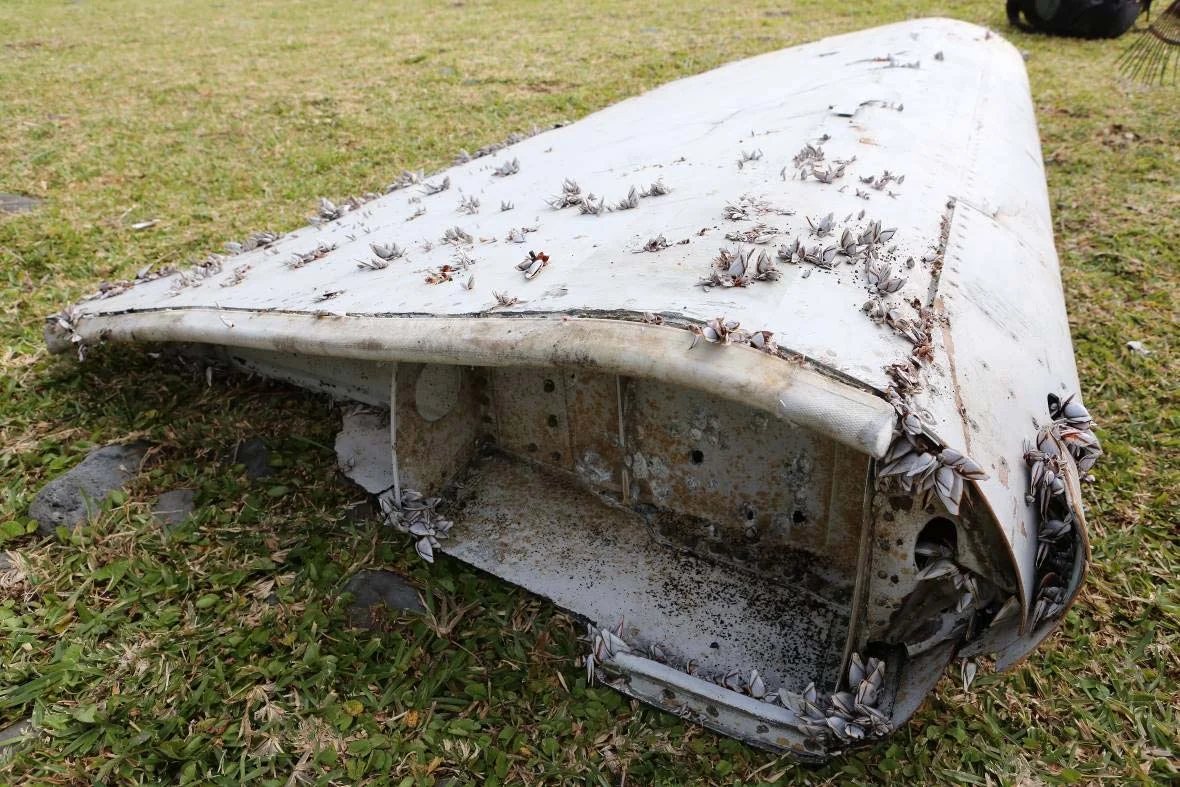
Flaperon (right wing)
Confirmed MH370First physical evidence of MH370. Boeing 777 flaperon positively identified by French BEA through serial number and maintenance records. Barnacle growth consistent with 16+ months in Indian Ocean.
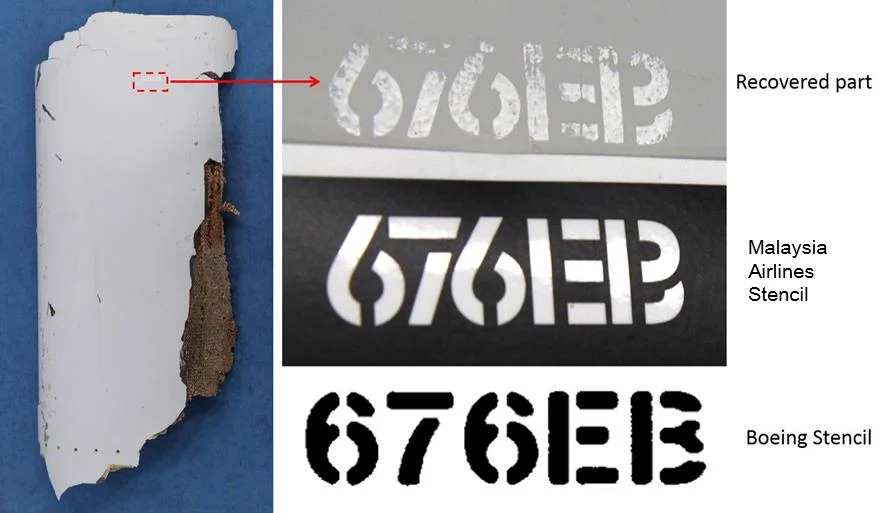
Flap fairing fragment
Confirmed MH370Found by independent searcher Blaine Gibson. Identified as 777 component by ATSB. Stencilling "676EB" matched Malaysia Airlines maintenance stencil pattern.
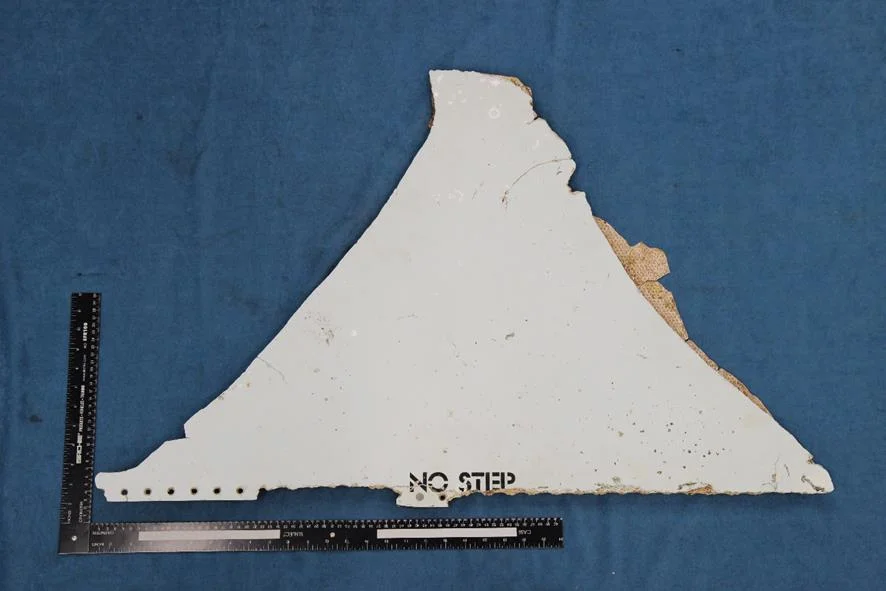
Horizontal stabiliser fragment
Confirmed MH370Large structural piece with "NO STEP" marking. Paint scheme and construction consistent with 9M-MRO (MH370 aircraft).
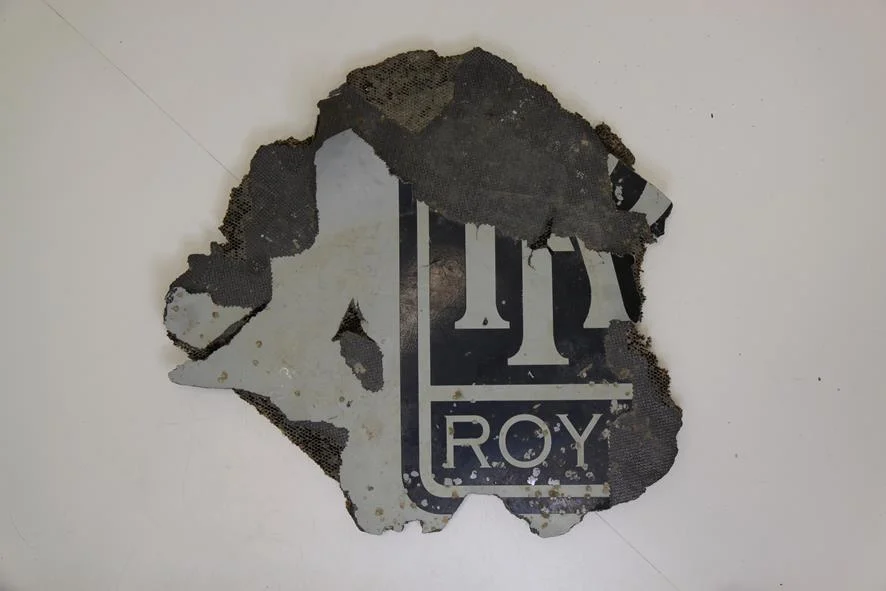
Engine cowling fragment
Confirmed MH370Rolls-Royce Trent 800 engine cowling with partial "ROY" lettering from Rolls-Royce branding. Manufacturing data consistent with MH370 aircraft engines.
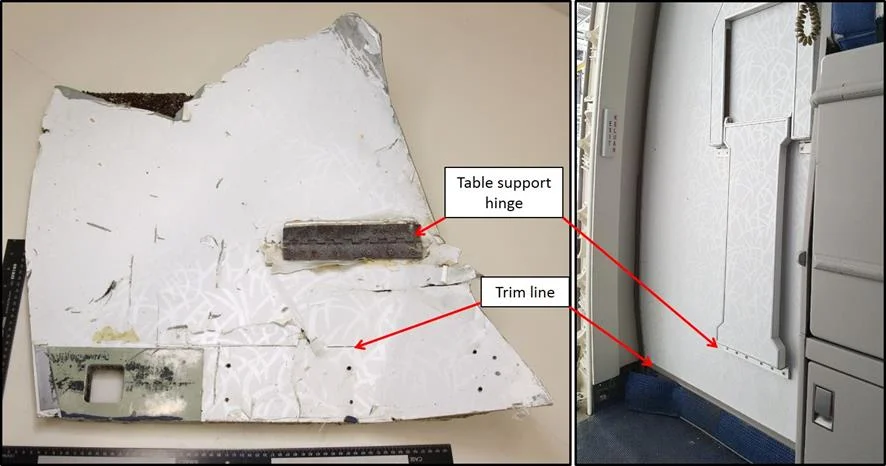
Interior panel fragment
Almost certain MH370Cabin interior bulkhead panel with table support hinge and trim line matching 777 economy class configuration. Pattern and construction compared directly to reference aircraft.
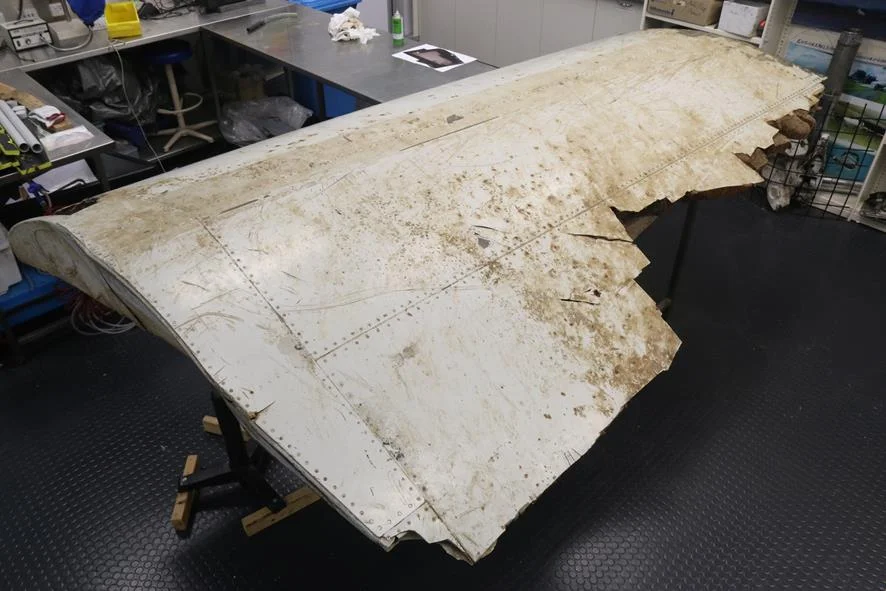
Wing flap segment
Confirmed MH370Right outboard wing flap. Confirmed by Malaysian investigation team as 9M-MRO component. ATSB analysis found flaps were in retracted position at separation.
Nose cone fragment
Almost certain MH370Radome or nose cone section. Boeing 777-compatible construction. Found at Mossel Bay by independent searcher.
Wing trailing edge
Almost certain MH370Trailing edge component. Marine biology analysis of attached organisms supports extended ocean exposure.
Additional fragments (25+)
Likely MH370Over 25 additional fragments recovered, mostly by independent searcher Blaine Gibson. Many classified as "almost certain" or "likely" MH370 based on materials and construction, though lacking unique serial numbers for definitive confirmation.
All Recovered Debris Mapped to Aircraft
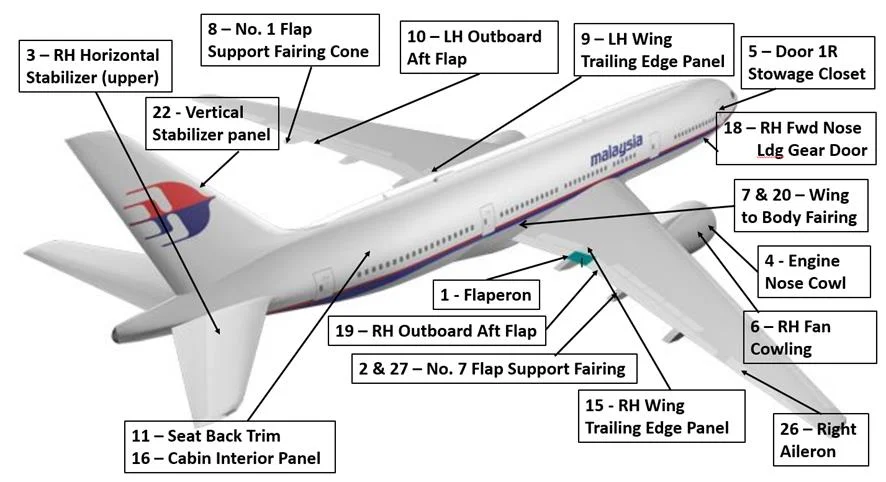
Source: Ministry of Transport Malaysia, published in ATSB "The Operational Search for MH370" (CC BY 3.0 AU). Numbers correspond to debris examination items in the Malaysian Safety Investigation Report appendices.
Flaperon Buoyancy Testing (France)
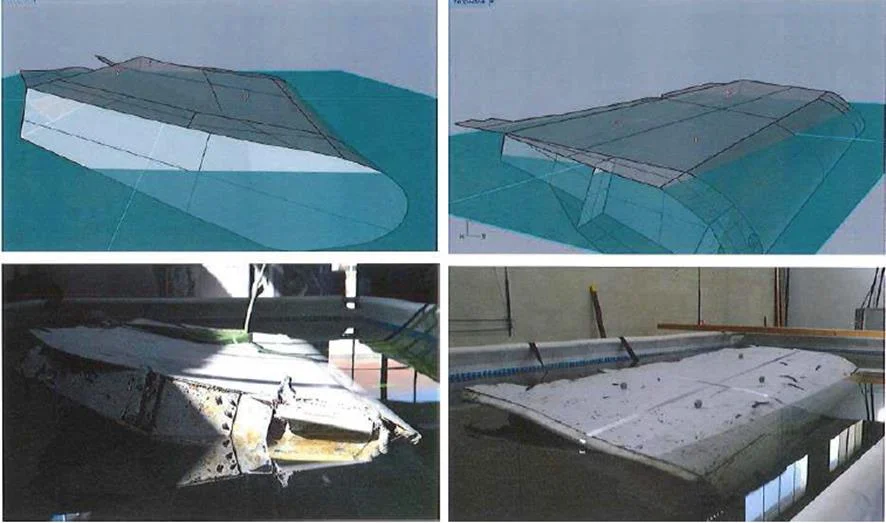
Source: Direction Generale de l'Armement Techniques Aeronautiques (DGA), published in ATSB report (CC BY 3.0 AU). Top: simulation models of flaperon flotation behaviour. Bottom: the actual MH370 flaperon during buoyancy testing at the DGA facility in Toulouse.
Debris photographs: Australian Transport Safety Bureau / Australian Government, from "MH370 - Search and debris examination update" (AE-2014-054, November 2016). Licensed under Creative Commons Attribution 3.0 Australia. Flaperon photo source: Bureau d'Enquetes et d'Analyses (BEA), published in ATSB report.
Debris Discovery Map
Discovery locations of confirmed MH370 debris across the Indian Ocean, with major ocean current flows. Pre-discovery drift models predicted debris would wash ashore in Western Australia; instead, the vast majority was found on African coastlines over 5,000 km away.
The Geographical Contradiction
Between July 2015 and June 2016, confirmed Boeing 777 wreckage washed ashore on coastlines thousands of kilometres from the presumed crash site. Where and when each piece appeared tells a story that doesn't neatly fit the official drift models.
Forbes' Argument
Pre-discovery drift models (CSIRO, UWA) predicted debris would reach Western Australia within 3–6 months, but debris overwhelmingly appeared on African coasts, 5,000+ km in the opposite direction.
If the aircraft crashed in the southern Indian Ocean (~34°S), prevailing currents should carry floating debris east toward Australia before any reaches Africa.
The debris pattern is more consistent with a crash point closer to the equatorial Indian Ocean, where the South Equatorial Current flows westward toward Africa.
Mainstream Counterargument
Post-discovery drift modelling (Durgadoo et al., 2021) demonstrates that debris from the 7th arc search area can reach both African and Australian coasts over 16+ months.
Multi-year ocean drift is stochastic: seasonal current variability, wind effects, and the Indian Ocean Dipole create highly complex dispersal patterns that simple current maps don't capture.
Reverse-drift modelling by Iannello/Ulich uses actual debris recovery points to narrow the entry point and supports a location along the 7th arc, consistent with Inmarsat data.
- Durgadoo et al., debris drift modelling (2021)
- CSIRO / UWA pre-discovery drift models (2014–2015) : Published in CSIRO technical reports
- Iannello & Godfrey, reverse-drift modelling
Chain of Custody
How debris was found, identified, and what forensic analysis reveals about the manner of impact.
Discovery Method
The flaperon was found by beachcombers on Réunion. The majority of subsequent pieces were discovered by Blaine Gibson, an independent American lawyer who funded his own search of African coastlines. Some critics have questioned how one person found so many pieces, though Gibson documented his systematic beach-walking methodology.
Identification Process
The flaperon was examined by the French BEA (Bureau d'Enquêtes et d'Analyses) under judicial authority. Subsequent pieces were assessed by the Malaysian investigation team and ATSB. Identification relies on part numbers, manufacturing stamps, paint analysis, and material composition matching Boeing 777-200ER specifications.
Forensic Indicators
The flaperon showed trailing edge damage consistent with high-energy water impact. French investigators found the flaperon was in the retracted position, potentially inconsistent with a controlled ditching (which would typically deploy flaps). Goose barnacles (Lepas anatifera) were found on the flaperon, but their size (largest ~36mm) suggested only 3–4 months of ocean growth, not the 16 months since the aircraft disappeared. This age discrepancy remains scientifically unresolved and appears across all recovered debris (see Barnacle Paradox below).
French Investigation
France opened its own judicial investigation into MH370 because French nationals were aboard. The BEA conducted independent analysis of the flaperon at their Toulouse facility. Their findings (which confirmed the part as MH370) were published separately from the Malaysian report and provide independent verification. The broader French judicial investigation went far beyond debris analysis, pursuing questions about SATCOM data integrity and US obstruction via Boeing trade secrets.
- French BEA, Flaperon Examination: Information Note No. 2 (2015) : Original BEA page removed; examination details in Malaysian Safety Investigation Report appendices
- Malaysian Safety Investigation Report (2018)
The Barnacle Paradox
Marine biology analysis of debris has produced an unresolved scientific puzzle that complicates simple interpretations of when and where the debris entered the ocean.
The Age Discrepancy
MH370 disappeared on March 8, 2014. The flaperon was found on July 29, 2015, a gap of ~16 months. Yet the largest goose barnacles (Lepas anatifera) on the flaperon measured approximately 36mm, suggesting only 3–4 months of ocean growth based on known growth rates. This ~12-month gap between the crash and the apparent start of barnacle colonisation appears on all recovered debris. Not one piece carries marine life consistent with 16 months of continuous ocean exposure.
The Flotation Paradox
When French DGA researchers placed the flaperon in a water tank in Toulouse, it floated at an angle with one long edge well above water. Yet this above-water edge was thickly colonised by Lepas barnacles, which require submersion and can't grow in air. Marine invertebrate expert Jim Carlton (Williams College) summarised: "Lepas don't lie"; the barnacle positions indicate the flaperon was fully submerged for an extended period, which contradicts its observed buoyancy.
Isotope Temperature Analysis
Oxygen isotope analysis of barnacle shells (Blamart & Bassinot, 2016) showed growth began at ~28°C (warm tropical waters) then dropped to 23–24°C. This contradicts the cold southern search zone (~38°S, where surface temps are ~12–18°C). Gregory Herbert's team (USF, AGU Advances, 2023) developed a stable isotope sclerochronology method to reconstruct drift paths from barnacle shell chemistry, but wasn't able to analyse the largest specimens. French authorities haven't released them for independent research.
Possible Explanations
Several hypotheses attempt to resolve the paradox: (1) barnacle growth rates may be slower than lab estimates suggest for open-ocean conditions with less food availability; (2) debris may have been beached or partially submerged for months before re-entering ocean circulation; (3) a 2024 analysis from 370Location.org suggests some barnacles may have colonised the flaperon after it beached on Réunion, during wave wash near shore. None of these explanations have been conclusively proven.
Unresolved, and it points away from the official story. The barnacle age discrepancy is a genuine scientific puzzle that marine biologists on all sides acknowledge. Not one recovered piece carries growth consistent with 16 months at sea, and the shell isotopes record warm tropical water, not the cold southern search zone. On its own it settles nothing. Stacked with the tropical organisms, the shore-dwelling species, and France's refusal to release the largest specimens, it becomes one more finding that's hard to square with a 2014 crash-and-drift from roughly 38°S.
Challenges to Debris Authenticity
Several researchers and journalists have raised specific concerns about the debris evidence. These arguments range from legitimate scientific anomalies to more speculative claims. The counterarguments are presented alongside each challenge.
Minimal Biofouling on Most Debris
Marine biologists who examined debris photographs noted surprisingly little marine growth. Cathryn Clarke Murray estimated the Mozambique pieces looked like they'd been in water "about a month." Sam Chan concluded "a couple of weeks, certainly not indicative of something in the water for multiple years." Geoscience Australia found all organisms were from tropical waters, not the cold southern Indian Ocean where the crash supposedly occurred.
Debris that beaches and re-floats can lose biofouling from sun exposure and sand abrasion. Over 16+ months of drift through both cold and warm waters, marine growth colonisation can restart multiple times. The tropical-zone organisms are consistent with debris spending its final months in warmer equatorial waters before landing on African/island coastlines.
The Blaine Gibson Question
Background
Blaine Alan Gibson (b. 1957) is the son of Phil Gibson, former Chief Justice of the California Supreme Court. He holds a master's degree from Johns Hopkins School of Advanced International Studies. He worked for the US State Department in Rio de Janeiro (1986-87), then spent a decade consulting in post-Soviet Russia, where he founded Siberia-Pacific Co. (1992) and a Russian-American pen-pal service. He speaks fluent Russian. In 2002, he participated in a workshop on small innovative firms in Russian nuclear cities. He describes himself as an "adventure lawyer" and previously searched for the Ark of the Covenant.
Gibson found roughly half of all suspected MH370 debris, more than every government search team combined. The circumstances of his discoveries raise questions that nobody has satisfactorily answered.
He found his first piece ("No Step") within 20 minutes of his first-ever beach search. In June 2016, he found multiple pieces while being filmed by a French TV crew. In December 2016, a piece apparently washed ashore within 30 minutes of Gibson passing a spot on Madagascar's 2,300-mile coastline. He reported finding debris being used by a nine-year-old girl to fan a kitchen fire.
Jeff Wise documented a consistent biofouling anomaly: nearly all Gibson-found debris showed minimal marine organism colonisation despite alleged months or years at sea. Tsunami debris, by contrast, is typically covered in barnacles and algae within weeks. The Gibson-found pieces looked, as Wise put it, "completely innocent of marine life."
Gibson systematically searched beaches in debris accumulation zones predicted by drift models. Other beachcombers and locals found pieces independently. The debris he recovered was examined by the ATSB and Malaysian authorities and confirmed as authentic Boeing 777 material with matching part numbers and paint schemes.
Planting 33+ pieces across 6 countries over 18 months, using genuine aircraft components with correct manufacturing data, would require access to a 777 parts inventory and coordination that goes well beyond any individual.
Forbes has defended Gibson against Wise's characterisations, and some researchers consider the statistical argument overblown given that Gibson was the only person systematically searching African beaches full-time.
Open question. The debris Gibson found is real; how one man recovered so much of it is what stays unsettled. His State Department background, decade in Russia, and the statistical improbability of his finds are worth pressing on. The detail that ties his finds to the wider case is the biofouling: the Gibson-recovered pieces carry the same sparse, tropical-water marine growth seen across the entire debris field, the pattern that keeps resisting a cold southern-ocean crash. This thread deserves more investigation, not less.
The Missing Identification Plate
The external serial number plate that should have been on the flaperon's inboard edge was missing. Florence de Changy has argued that ID plates "are only removed on decommissioned planes," suggesting the part could have come from a scrapped aircraft rather than MH370.
French BEA investigators used an endoscope to read internal identification numbers, and one of three series of numbers matched MH370's Boeing 777 (9M-MRO). The flaperon was formally confirmed as MH370 on September 3, 2015. External plates can be dislodged by impact forces and ocean abrasion over 16 months. A Rolls-Royce engine cowling fragment was also confirmed through internal manufacturing data.
Shore-Dwelling Species on Open-Ocean Debris
Geoscience Australia found two-thirds of molluscs on debris were shallow coastal species, not open-ocean species. The "No Step" piece carried Petaloconchus renisectus (a shore-dwelling sea snail) and serpulid tube worms "usually found living on the seabed rather than floating debris." Two moderately old specimens (~8 months) were shore-dwelling species, suggesting debris was near a coastline approximately 8 months before washing ashore.
Debris that beaches in shallow waters and is re-floated by storms will accumulate coastal species. Over 16 months of drift, pieces may beach and re-float multiple times. This is consistent with drift models showing debris reaching African and island coastlines within 6–12 months, where shore-dwelling organisms could attach before the debris was pushed further along the coast or found.
Genuine parts, an anomalous drift story. The planting hypothesis collapses on the practicalities: sourcing authentic 777 components with matching serial numbers, paint, and maintenance data, then seeding them across six countries with no leak, is not a feasible operation. So the debris is real Boeing 777 material. What it doesn't do is confirm the official account. The tropical-water organisms, the roughly 4-month barnacle growth against 16 months at sea, and the shore-dwelling species all point somewhere other than a cold 38°S crash followed by a clean 16-month drift. The parts are authentic; the mainstream drift story attached to them is the part that struggles to explain the biology.
- Jeff Wise, MH370 Debris Was Planted, Ineptly (2016)
- Jeff Wise, Bioforensic Analysis of Suspected MH370 Debris (2016)
- Florence de Changy, The Disappearing Act (2021) : Published by HarperCollins
- Airline Ratings, MH370 Debris: Now For The Facts (2018)
What the Debris Tells Us
Unlike satellite data or radar traces, wreckage can be touched, weighed, and chemically tested. How it's interpreted shapes the search strategy and determines which theories remain viable.
Entry Point Implications
If debris drifted from the 7th arc, the current Ocean Infinity search is looking in the right area.
Reverse-drift modelling from actual recovery points narrows the probable entry point more than forward modelling from assumed crash locations.
The 2026 search zone was partially informed by debris drift analysis, adding independent confirmation beyond Inmarsat data alone.
Open Questions
The barnacle age discrepancy (~4 months of growth vs 16 months at sea) remains scientifically unresolved. No single explanation (beaching, variable growth rates, post-landing colonisation) fully accounts for the pattern across all 33+ pieces.
France hasn't released the largest flaperon barnacle specimens for independent research, despite requests from Gregory Herbert's team (USF). This limits the scientific community's ability to resolve the isotope and growth-rate questions definitively.
The debris planting hypothesis faces significant practical objections (sourcing authentic 777 parts with matching serial numbers, paint, and manufacturing data, coordinated across 6 countries with no leaks), but the biofouling anomalies are real and demand better explanation.
Three searches, no wreckage. Ocean Infinity's 2026 deep-sea search, guided by debris-derived drift models and independent flight-path work, again found nothing, bringing the total to three major campaigns across 240,000+ sq km of seabed with no trace of the aircraft. Line up what the debris actually shows: authentic 777 parts carrying tropical, low-growth marine life; barnacles that record warm water rather than the frigid southern search zone; France still holding the specimens that could settle the timeline; and every deep-water search of the modeled crash site coming up empty. Any single anomaly is survivable. Together they weigh against the official southern-Indian-Ocean crash-and-drift story and toward the reading the rest of this site argues, that MH370's fate stays unresolved and the Inmarsat-only reconstruction doesn't fully account for where these pieces came from. The debris is real; the tidy drift narrative attached to it is what keeps failing its own tests. For the wider case, see the ocean search tracker, the Inmarsat analysis, and the satellite video forensics.